Advertisements
Advertisements
प्रश्न
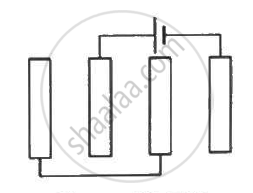
Each of the plates shown in figure has surface area `(96/∈_0) xx 10^-12` Fm on one side and the separation between the consecutive plates is 4⋅0 mm. The emf of the battery connected is 10 volts. Find the magnitude of the charge supplied by the battery to each of the plates connected to it.
Advertisements
उत्तर
Here, three capacitors are formed and each of them has area A.
Now ,
`A = 96/∈_0 xx 10^-12 "F" - "m"`
d = 4 mm
`= 3 xx 10^-3 "m"`
The capacitance of the capacitors is given by
`C = (∈_0A)/d = (∈_0(96/∈_0) xx 10^-12)/(4 xx 10^-3)` = `24 xx 10^-9 "F"`
Because the three capacitors are arranged in series, the equivalent capacitance is given by
`C_(eq) = (24 xx 10^-9)/3 = 8 xx 10^-9 F`
The total charge on the capacitor is given by
Q = CeqV
`⇒ Q = 8 xx 10^-9 xx 10`
`⇒ Q = 8 xx 10^-8 "C"`
The charge on a single plate is given by
`Q_p = 2 xx 8 xx 10^-8`
`⇒ Q_p = 16 xx 10^-8 = 0.16 "uC"`
APPEARS IN
संबंधित प्रश्न
A capacitor of capacitance C is charged fully by connecting it to a battery of emf E. It is then disconnected from the battery. If the separation between the plates of the capacitor is now doubled, how will the following change?
(i) charge stored by the capacitor.
(ii) Field strength between the plates.
(iii) Energy stored by the capacitor.
Justify your answer in each case.
Two metal spheres of capacitance C1 and C2 carry some charges. They are put in contact and then separated. The final charges Q1 and Q2 on them will satisfy
When 1⋅0 × 1012 electrons are transferred from one conductor to another, a potential difference of 10 V appears between the conductors. Calculate the capacitance of the two-conductor system.
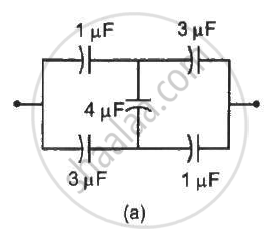
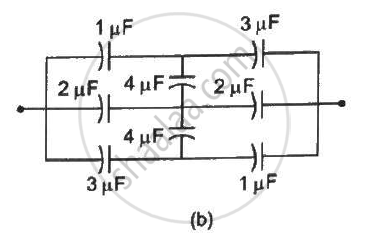
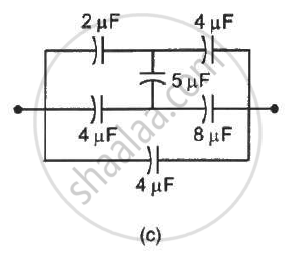
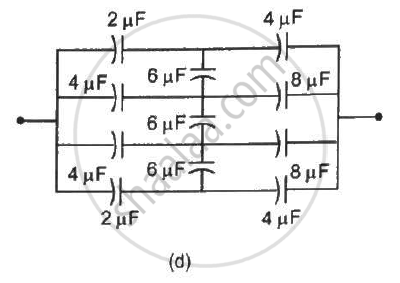
Find the equivalent capacitances of the combinations shown in figure between the indicated points.
A capacitor of capacitance 10 μF is connected to a battery of emf 2 V. It is found that it takes 50 ms for the charge of the capacitor to become 12.6 μC. Find the resistance of the circuit.
A parallel-plate capacitor has plate area 100 cm2 and plate separation 1⋅0 cm. A glass plate (dielectric constant 6⋅0) of thickness 6⋅0 mm and an ebonite plate (dielectric constant 4⋅0) are inserted one over the other to fill the space between the plates of the capacitor. Find the new capacitance.
A parallel-plate capacitor of plate area A and plate separation d is charged to a potential difference V and then the battery is disconnected. A slab of dielectric constant K is then inserted between the plates of the capacitor so as to fill the space between the plates. Find the work done on the system in the process of inserting the slab.
Derive the expression for resultant capacitance, when the capacitor is connected in series.
When air is replaced by a dielectric medium of constant K, the maximum force of attraction between two charges separated by a distance ______.
The capacitance of a parallel plate capacitor is 60 µF. If the distance between the plates is tripled and area doubled then new capacitance will be ______.
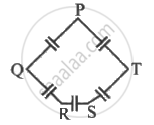
Five capacitor each of capacitance value C are connected as shown in the figure. The ratio of capacitance between P to R, and the capacitance between P and Q is ______.
The radius of a sphere of capacity 1 microfarad in the air is ______
The material filled between the plates of a parallel plate capacitor has a resistivity of 200Ωm. The value of the capacitance of the capacitor is 2 pF. If a potential difference of 40V is applied across the plates of the capacitor, then the value of leakage current flowing out of the capacitor is ______.
(given the value of relative permittivity of a material is 50.)
A capacitor of capacity 2 µF is charged to a potential difference of 12 V. It is then connected across an inductor of inductance 0.6 mH. The current in the circuit at a time when the potential difference across the capacitor is 6.0 V is ______ × 10-1A.
Calculate equivalent capacitance of the circuit shown in the Figure given below:

For a given capacitor, what fixes its capacitance?
In a series combination, which statement describes the potential difference across each capacitor?
In a series combination, which capacitor gets a larger potential difference?
