Advertisements
Advertisements
प्रश्न
During a thunder storm, the movement of water molecules within the clouds creates friction, partially causing the bottom part of the clouds to become negatively charged. This implies that the bottom of the cloud and the ground act as a parallel plate capacitor. If the electric field between the cloud and ground exceeds the dielectric breakdown of the air (3 × 10⁶ Vm–1), lightning will occur.
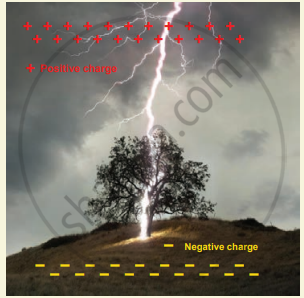
- If the bottom part of the cloud is 1000 m above the ground, determine the electric potential difference that exists between the cloud and ground.
- In a typical lightning phenomenon, around 25 C of electrons are transferred from cloud to ground. How much electrostatic potential energy is transferred to the ground?
Advertisements
उत्तर
- Electric field between the cloud and ground,
V = E.d
V= 3 x 106 x 1000 = 3 x 10⁹V - Electrons transfered from cloud to ground,
q = 25 C
Electron static potential energy,
U = `1/2 "CV"^2`
`["C" = "q"/"V"]`
`= 1/2 "qV" = 1/2 xx 25 xx 3 xx 10^9`
U = 37.5 x 10⁹ J
APPEARS IN
संबंधित प्रश्न
Three capacitors of capacitances 6 µF each are available. The minimum and maximum capacitances, which may be obtained are
Following operations can be performed on a capacitor:
X − connect the capacitor to a battery of emf ε.
Y − disconnect the battery.
Z − reconnect the battery with polarity reversed.
W − insert a dielectric slab in the capacitor.
(a) In XYZ (perform X, then Y, then Z) the stored electric energy remains unchanged and no thermal energy is developed.
(b) The charge appearing on the capacitor is greater after the action XWY than after the action XYZ.
(c) The electric energy stored in the capacitor is greater after the action WXY than after the action XYW.
(d) The electric field in the capacitor after the action XW is the same as that after WX.
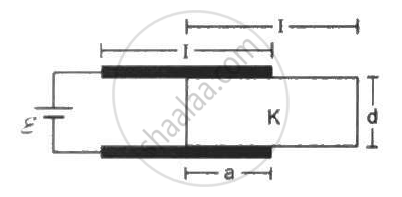
Consider the situation shown in figure. The plates of the capacitor have plate area A and are clamped in the laboratory. The dielectric slab is released from rest with a length a inside the capacitor. Neglecting any effect of friction or gravity, show that the slab will execute periodic motion and find its time period.
Define ‘capacitance’. Give its unit.
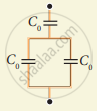
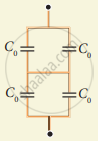
Calculate the resultant capacitances for each of the following combinations of capacitors.
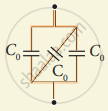
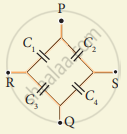
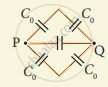
When air is replaced by a dielectric medium of constant K, the maximum force of attraction between two charges separated by a distance ______.
A leaky parallel plate capacitor is filled completely with a material having dielectric constant K = 5 and electric conductivity σ = 7.4 × 10⁻¹² Ω-1 m-1. If the charge on the plate at the instant t = 0 is q = 8.85 µC, then the leakage current at the instant t = 12 s is ______ × 10-1 µA.
Current versus time and voltage versus time graphs of a circuit element are shown in figure.
 |
 |
The type of the circuit element is ______.
Calculate equivalent capacitance of the circuit shown in the Figure given below:

Which system is called a capacitor?
