Advertisements
Advertisements
प्रश्न
An LR circuit having a time constant of 50 ms is connected with an ideal battery of emf ε. find the time elapsed before (a) the current reaches half its maximum value, (b) the power dissipated in heat reaches half its maximum value and (c) the magnetic field energy stored in the circuit reaches half its maximum value.
Advertisements
उत्तर
Given:-
Time constant of the LR circuit = 50 ms
Emf of the battery = ε
The time constant of the LR circuit is given by
\[\tau = \frac{L}{R} = 50 ms = 0 . 05 s\]
Let the current reach half of its maximum value in time t.
Now,
\[\frac{i_0}{2} = i_0 (1 - e^{- t/0 . 05} )\]
\[ \Rightarrow \frac{1}{2} = 1 - e^{- t/0 . 05} \]
\[ \Rightarrow e^{- t/0 . 03} = \frac{1}{2}\]
On taking natural logarithm (ln) on both sides, we get
\[\ln e^{- t/0 . 05} = \ln\left( \frac{1}{2} \right)\]
\[ \Rightarrow - \frac{t}{0 . 05} = \ln(1) - \ln(2)\]
\[ \Rightarrow - \frac{t}{0 . 05} = 0 - 0.6931\]
\[ \Rightarrow t = 0 . 05 \times 0 . 6931\]
\[ = 0 . 03465 s\]
\[ = 35 ms\]
(b) Let t be the time at which the power dissipated is half its maximum value.
Maximum power = `E^2/R`
\[\therefore \frac{E^2}{2R} = \frac{E^2}{R}(1 - e^{tR/L} )^2 \]
\[ \Rightarrow 1 - e^{- R/L} = \frac{1}{\sqrt{2}} = 0 . 707\]
\[ \Rightarrow e^{- tR/L} = 0 . 293\]
\[ \Rightarrow t = 50 \times 1 . 2275 ms\]
\[ = 61 . 2 ms\]
(c) Current in the coil at the steady state, `i = epsilon/R`
Magnetic field energy stored at the steady state,
\[U = \frac{1}{2}L i^2\text{ or }U\]
\[= \frac{\epsilon^2}{2 R^2}L\]
Half of the value of the steady-state energy = \[\frac{1}{4}L\frac{\epsilon^2}{R^2}\]
Now,
\[\frac{1}{4}L\frac{\epsilon^2}{R^2} = \frac{1}{2}L\frac{\epsilon^2}{R^2}(1 - e^{- tR/L} )^2 \]
\[ \Rightarrow e^{- tR/L} = \frac{\sqrt{2} - 1}{\sqrt{2}} = \frac{2 - \sqrt{2}}{2}\]
\[ \Rightarrow t = \tau\left[ \ln\left( \frac{1}{2 - \sqrt{2}} \right) + \ln 2 \right]\]
\[= 0 . 05\left[ \ln\left( \frac{1}{2 - \sqrt{2}} \right) + \ln 2 \right]\]
\[= 0 . 061 s\]
\[= 61 ms\]
APPEARS IN
संबंधित प्रश्न
In a series LCR circuit connected to an a.c. source of voltage v = vmsinωt, use phasor diagram to derive an expression for the current in the circuit. Hence, obtain the expression for the power dissipated in the circuit. Show that power dissipated at resonance is maximum
A voltage V = V0 sin ωt is applied to a series LCR circuit. Derive the expression for the average power dissipated over a cycle. Under what condition (i) no power is dissipated even though the current flows through the circuit, (ii) maximum power is dissipated in the circuit?
Show that in an a.c. circuit containing a pure inductor, the voltage is ahead of current by π/2 in phase ?
Find the value of t/τ for which the current in an LR circuit builds up to (a) 90%, (b) 99% and (c) 99.9% of the steady-state value.
The time constant of an LR circuit is 40 ms. The circuit is connected at t = 0 and the steady-state current is found to be 2.0 A. Find the current at (a) t = 10 ms (b) t = 20 ms, (c) t = 100 ms and (d) t = 1 s.
An inductor-coil of resistance 10 Ω and inductance 120 mH is connected across a battery of emf 6 V and internal resistance 2 Ω. Find the charge which flows through the inductor in (a) 10 ms, (b) 20 ms and (c) 100 ms after the connections are made.
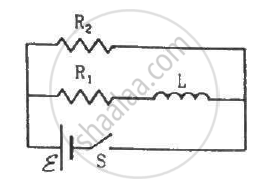
Consider the circuit shown in figure. (a) Find the current through the battery a long time after the switch S is closed. (b) Suppose the switch is again opened at t = 0. What is the time constant of the discharging circuit? (c) Find the current through the inductor after one time constant.
Answer the following question.
In a series LCR circuit connected across an ac source of variable frequency, obtain the expression for its impedance and draw a plot showing its variation with frequency of the ac source.
Answer the following question.
What is the phase difference between the voltages across the inductor and the capacitor at resonance in the LCR circuit?
Keeping the source frequency equal to the resonating frequency of the series LCR circuit, if the three elements, L, C and R are arranged in parallel, show that the total current in the parallel LCR circuit is minimum at this frequency. Obtain the current rms value in each branch of the circuit for the elements and source specified for this frequency.
In series combination of R, L and C with an A.C. source at resonance, if R = 20 ohm, then impedence Z of the combination is ______.
Assertion: When the frequency of the AC source in an LCR circuit equals the resonant frequency, the reactance of the circuit is zero, and so there is no current through the inductor or the capacitor.
Reason: The net current in the inductor and capacitor is zero.
To reduce the resonant frequency in an LCR series circuit with a generator ______.
A series RL circuit with R = 10 Ω and L = `(100/pi)` mH is connected to an ac source of voltage V = 141 sin (100 πt), where V is in volts and t is in seconds. Calculate
- the impedance of the circuit
- phase angle, and
- the voltage drop across the inductor.
Select the most appropriate option with regard to resonance in a series LCR circuit.
A series LCR circuit (L = 10 H, C = 10 µF, R = 50 Ω) is connected to V = 200 sin (100t). If ν0 is the resonant frequency and ν is the source frequency, then ______.
A 20Ω resistance, 10 mH inductance coil and 15µF capacitor are joined in series. When a suitable frequency alternating current source is joined to this combination, the circuit resonates. If the resistance is made \[\frac {1}{3}\] rd, the resonant frequency ______.
A resistance of 200Ω and an inductor of \[\frac {1}{2π}\]Н are connected in series to a.c. voltage of 40 V and 100 Hz frequency. The phase angle between the voltage and current is ______.
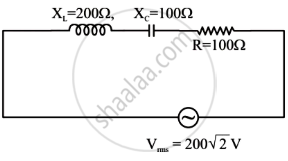
In the given circuit, rms value of current (Irms) through the resistor R is: