Advertisements
Advertisements
Question
An LR circuit having a time constant of 50 ms is connected with an ideal battery of emf ε. find the time elapsed before (a) the current reaches half its maximum value, (b) the power dissipated in heat reaches half its maximum value and (c) the magnetic field energy stored in the circuit reaches half its maximum value.
Advertisements
Solution
Given:-
Time constant of the LR circuit = 50 ms
Emf of the battery = ε
The time constant of the LR circuit is given by
\[\tau = \frac{L}{R} = 50 ms = 0 . 05 s\]
Let the current reach half of its maximum value in time t.
Now,
\[\frac{i_0}{2} = i_0 (1 - e^{- t/0 . 05} )\]
\[ \Rightarrow \frac{1}{2} = 1 - e^{- t/0 . 05} \]
\[ \Rightarrow e^{- t/0 . 03} = \frac{1}{2}\]
On taking natural logarithm (ln) on both sides, we get
\[\ln e^{- t/0 . 05} = \ln\left( \frac{1}{2} \right)\]
\[ \Rightarrow - \frac{t}{0 . 05} = \ln(1) - \ln(2)\]
\[ \Rightarrow - \frac{t}{0 . 05} = 0 - 0.6931\]
\[ \Rightarrow t = 0 . 05 \times 0 . 6931\]
\[ = 0 . 03465 s\]
\[ = 35 ms\]
(b) Let t be the time at which the power dissipated is half its maximum value.
Maximum power = `E^2/R`
\[\therefore \frac{E^2}{2R} = \frac{E^2}{R}(1 - e^{tR/L} )^2 \]
\[ \Rightarrow 1 - e^{- R/L} = \frac{1}{\sqrt{2}} = 0 . 707\]
\[ \Rightarrow e^{- tR/L} = 0 . 293\]
\[ \Rightarrow t = 50 \times 1 . 2275 ms\]
\[ = 61 . 2 ms\]
(c) Current in the coil at the steady state, `i = epsilon/R`
Magnetic field energy stored at the steady state,
\[U = \frac{1}{2}L i^2\text{ or }U\]
\[= \frac{\epsilon^2}{2 R^2}L\]
Half of the value of the steady-state energy = \[\frac{1}{4}L\frac{\epsilon^2}{R^2}\]
Now,
\[\frac{1}{4}L\frac{\epsilon^2}{R^2} = \frac{1}{2}L\frac{\epsilon^2}{R^2}(1 - e^{- tR/L} )^2 \]
\[ \Rightarrow e^{- tR/L} = \frac{\sqrt{2} - 1}{\sqrt{2}} = \frac{2 - \sqrt{2}}{2}\]
\[ \Rightarrow t = \tau\left[ \ln\left( \frac{1}{2 - \sqrt{2}} \right) + \ln 2 \right]\]
\[= 0 . 05\left[ \ln\left( \frac{1}{2 - \sqrt{2}} \right) + \ln 2 \right]\]
\[= 0 . 061 s\]
\[= 61 ms\]
APPEARS IN
RELATED QUESTIONS
Define 'quality factor' of resonance in a series LCR circuit. What is its SI unit?
In a series LCR circuit connected to an a.c. source of voltage v = vmsinωt, use phasor diagram to derive an expression for the current in the circuit. Hence, obtain the expression for the power dissipated in the circuit. Show that power dissipated at resonance is maximum
An inductor-coil of resistance 10 Ω and inductance 120 mH is connected across a battery of emf 6 V and internal resistance 2 Ω. Find the charge which flows through the inductor in (a) 10 ms, (b) 20 ms and (c) 100 ms after the connections are made.
Two coils A and B have inductances 1.0 H and 2.0 H respectively. The resistance of each coil is 10 Ω. Each coil is connected to an ideal battery of emf 2.0 V at t = 0. Let iA and iBbe the currents in the two circuit at time t. Find the ratio iA / iB at (a) t = 100 ms, (b) t = 200 ms and (c) t = 1 s.
A constant current exists in an inductor-coil connected to a battery. The coil is short-circuited and the battery is removed. Show that the charge flown through the coil after the short-circuiting is the same as that which flows in one time constant before the short-circuiting.
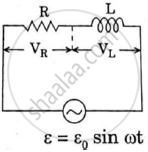
An ac circuit as shown in the figure has an inductor of inductance L and a resistor or resistance R connected in series. Using the phasor diagram, explain why the voltage in the circuit will lead the current in phase.
The potential difference across the resistor is 160V and that across the inductor is 120V. Find the effective value of the applied voltage. If the effective current in the circuit be 1.0 A, calculate the total impedance of the circuit.
What will be the potential difference in the circuit when direct current is passed through the circuit?
Obtain the resonant frequency and Q-factor of a series LCR circuit with L = 3.0 H, C = 27 µF, and R = 7.4 Ω. It is desired to improve the sharpness of the resonance of the circuit by reducing its ‘full width at half maximum’ by a factor of 2. Suggest a suitable way.
In an L.C.R. series a.c. circuit, the current ______.
To reduce the resonant frequency in an LCR series circuit with a generator ______.
A coil of 0.01 henry inductance and 1 ohm resistance is connected to 200 volt, 50 Hz ac supply. Find the impedance of the circuit and time lag between max. alternating voltage and current.
Which of the following statements about a series LCR circuit connected to an ac source is correct?
Three students, X, Y and Z performed an experiment for studying the variation of ac with frequency in a series LCR circuit and obtained the graphs as shown below. They all used
- an AC source of the same emf and
- inductance of the same value.

- Who used minimum resistance?
- In which case will the quality Q factor be maximum?
- What did the students conclude about the nature of impedance at resonant frequency (f0)?
- An ideal capacitor is connected across 220 V, 50 Hz, and 220 V, 100 Hz supplies. Find the ratio of current flowing through it in the two cases.
A series LCR circuit (L = 10 H, C = 10 µF, R = 50 Ω) is connected to V = 200 sin (100t). If ν0 is the resonant frequency and ν is the source frequency, then ______.
A 20Ω resistance, 10 mH inductance coil and 15µF capacitor are joined in series. When a suitable frequency alternating current source is joined to this combination, the circuit resonates. If the resistance is made \[\frac {1}{3}\] rd, the resonant frequency ______.
To an ac power supply of 220 V at 50 Hz, a resistor of 20 Ω, a capacitor of reactance 25 Ω and an inductor of reactance 45 Ω are connected in series. The corresponding current in the circuit and the phase angle between the current and the voltage is respectively:
Which expression gives the sinusoidally varying voltage applied by the AC source?
