Advertisements
Advertisements
Question
Show that in an a.c. circuit containing a pure inductor, the voltage is ahead of current by π/2 in phase ?
Advertisements
Solution
AC voltage applied to an inductor
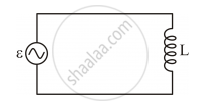
Source, v = vm sin ωt
Using Kirchhoff’s loop rule,
`sum epsi(t) =0`
`v - (Ldi)/dt =0 `
`(di)/dt =v/L =v_m/L sin omegat`
Integrating di/dt with respect to time,
`int (di)/dt dt =v_m/L int sin(omega)dt`
`i=-(v_m)/omegaL cos (omegat) +`constant
`-cos omegat = sin(omegat -pi/2)`
`therefore i =i_msin (omegat - pi/2)`
`because`Where,`i_m = (v_m)/(omegaL)`is the amplitude of current
APPEARS IN
RELATED QUESTIONS
An LR circuit contains an inductor of 500 mH, a resistor of 25.0 Ω and an emf of 5.00 V in series. Find the potential difference across the resistor at t = (a) 20.0 ms, (b) 100 ms and (c) 1.00 s.
A solenoid having inductance 4.0 H and resistance 10 Ω is connected to a 4.0 V battery at t = 0. Find (a) the time constant, (b) the time elapsed before the current reaches 0.63 of its steady-state value, (c) the power delivered by the battery at this instant and (d) the power dissipated in Joule heating at this instant.
The current in a discharging LR circuit without the battery drops from 2.0 A to 1.0 A in 0.10 s. (a) Find the time constant of the circuit. (b) If the inductance of the circuit 4.0 H, what is its resistance?
(i) An a.c. source of emf ε = 200 sin omegat is connected to a resistor of 50 Ω . calculate :
(1) Average current (`"I"_("avg")`)
(2) Root mean square (rms) value of emf
(ii) State any two characteristics of resonance in an LCR series circuit.
In a series LCR circuit supplied with AC, ______.
At resonance frequency the impedance in series LCR circuit is ______.
In series LCR AC-circuit, the phase angle between current and voltage is
The phase diffn b/w the current and voltage at resonance is
For an LCR circuit driven at frequency ω, the equation reads
`L (di)/(dt) + Ri + q/C = v_i = v_m` sin ωt
- Multiply the equation by i and simplify where possible.
- Interpret each term physically.
- Cast the equation in the form of a conservation of energy statement.
- Integrate the equation over one cycle to find that the phase difference between v and i must be acute.
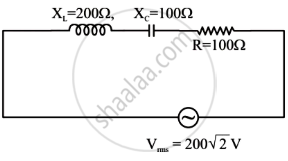
In the given circuit, rms value of current (Irms) through the resistor R is: