Advertisements
Advertisements
Question
A series LCR circuit with L = 0.12 H, C = 480 nF, R = 23 Ω is connected to a 230 V variable frequency supply.
(a) What is the source frequency for which current amplitude is maximum. Obtain this maximum value.
(b) What is the source frequency for which average power absorbed by the circuit is maximum. Obtain the value of this maximum power.
(c) For which frequencies of the source is the power transferred to the circuit half the power at resonant frequency? What is the current amplitude at these frequencies?
(d) What is the Q-factor of the given circuit?
Advertisements
Solution
Inductance, L = 0.12 H
Capacitance, C = 480 nF = 480 × 10−9 F
Resistance, R = 23 Ω
Supply voltage, V = 230 V
Peak voltage is given as:
V0 = `sqrt2 xx 230` = 325.22 V
(a) Current flowing in the circuit is given by the relation,
I0 = `"V"_0/(sqrt("R"^2 + (ω"L" - 1/(ω"C"))^2`
Where,
I0 = maximum at resonance
At resonance, we have
`ω_"R""L" - 1/(ω_"R""C")` = 0
Where,
ωR = Resonance angular frequency
∴ ωR = `1/sqrt("LC")`
= `1/sqrt(0.12 xx 480 xx 10^-9)`
= 4166.67 rad/s
∴ Resonant frequency, vR = `ω_"R"/(2π) = 4166.67/(2 xx 3.14)` = 663.48 Hz
And, maximum current `("I"_0)_"Max" = "V"_0/"R" = 325.22/23` = 14.14 A
(b) Maximum average power absorbed by the circuit is given as:
`("P"_"av")_"Max" = 1/2 ("I"_0)_"Max"^2 "R"`
= `1/2 xx (14.14)^2 xx 23`
= 2299.3 W
Hence, resonant frequency (vR) is 663.48 Hz.
(c) The power transferred to the circuit is half the power at resonant frequency.
Frequencies at which power transferred is half, = ωR ± Δω
= `2π ("v"_"R" ± Δ"v")`
Where,
Δω = `"R"/(2"L")`
= `23/(2 xx 0.12)`
= 95.83 rad/s
Hence, change in frequency, Δv = `1/(2π)Δω = 95.83/(2π)` = 15.26 Hz
∴ vR + Δv = 663.48 + 15.26 = 678.74 Hz
And, vR − Δv = 663.48 − 15.26 = 648.22 Hz
Hence, at 648.22 Hz and 678.74 Hz frequencies, the power transferred is half.
At these frequencies, current amplitude can be given as:
I' = `1/sqrt2 xx ("I"_0)_"Max"`
= `14.14/sqrt2`
= 10 A
(d) Q-factor of the given circuit can be obtained using the relation, Q = `(ω_"R""L")/"R"`
= `(4166.67 xx 0.12)/23`
= 21.74
Hence, the Q-factor of the given circuit is 21.74.
APPEARS IN
RELATED QUESTIONS
In a series LCR circuit connected to an a.c. source of voltage v = vmsinωt, use phasor diagram to derive an expression for the current in the circuit. Hence, obtain the expression for the power dissipated in the circuit. Show that power dissipated at resonance is maximum
(i) Find the value of the phase difference between the current and the voltage in the series LCR circuit shown below. Which one leads in phase : current or voltage ?
(ii) Without making any other change, find the value of the additional capacitor C1, to be connected in parallel with the capacitor C, in order to make the power factor of the circuit unity.
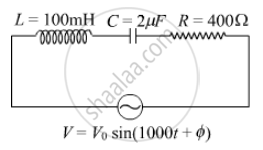
In a series LCR circuit, obtain the condition under which watt-less current flows in the circuit ?
Show that in an a.c. circuit containing a pure inductor, the voltage is ahead of current by π/2 in phase ?
A coil of resistance 40 Ω is connected across a 4.0 V battery. 0.10 s after the battery is connected, the current in the coil is 63 mA. Find the inductance of the coil.
The magnetic field at a point inside a 2.0 mH inductor-coil becomes 0.80 of its maximum value in 20 µs when the inductor is joined to a battery. Find the resistance of the circuit.
Two coils A and B have inductances 1.0 H and 2.0 H respectively. The resistance of each coil is 10 Ω. Each coil is connected to an ideal battery of emf 2.0 V at t = 0. Let iA and iBbe the currents in the two circuit at time t. Find the ratio iA / iB at (a) t = 100 ms, (b) t = 200 ms and (c) t = 1 s.
In a series LCR circuit supplied with AC, ______.
At resonant frequency the current amplitude in series LCR circuit is ______.
Which of the following components of an LCR circuit, with a.c. supply, dissipates energy?
Which of the following combinations should be selected for better tuning of an LCR circuit used for communication?
In series LCR circuit, the plot of Imax vs ω is shown in figure. Find the bandwidth and mark in the figure.

A coil of 0.01 henry inductance and 1 ohm resistance is connected to 200 volt, 50 Hz ac supply. Find the impedance of the circuit and time lag between max. alternating voltage and current.
Which of the following statements about a series LCR circuit connected to an ac source is correct?
A series LCR circuit (L = 10 H, C = 10 µF, R = 50 Ω) is connected to V = 200 sin (100t). If ν0 is the resonant frequency and ν is the source frequency, then ______.
Which of the following combinations should be selected for better tuning of an L-C-R circuit used for communication?
In the given circuit, rms value of current (Irms) through the resistor R is:
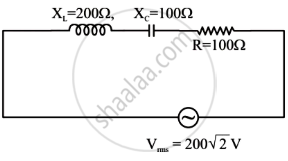
Out of the following which one is NOT the characteristic of LCR series resonant circuit?
Which law is applied around the loop to obtain the circuit equation?
