Advertisements
Advertisements
प्रश्न
A series LCR circuit with L = 0.12 H, C = 480 nF, R = 23 Ω is connected to a 230 V variable frequency supply.
(a) What is the source frequency for which current amplitude is maximum. Obtain this maximum value.
(b) What is the source frequency for which average power absorbed by the circuit is maximum. Obtain the value of this maximum power.
(c) For which frequencies of the source is the power transferred to the circuit half the power at resonant frequency? What is the current amplitude at these frequencies?
(d) What is the Q-factor of the given circuit?
Advertisements
उत्तर
Inductance, L = 0.12 H
Capacitance, C = 480 nF = 480 × 10−9 F
Resistance, R = 23 Ω
Supply voltage, V = 230 V
Peak voltage is given as:
V0 = `sqrt2 xx 230` = 325.22 V
(a) Current flowing in the circuit is given by the relation,
I0 = `"V"_0/(sqrt("R"^2 + (ω"L" - 1/(ω"C"))^2`
Where,
I0 = maximum at resonance
At resonance, we have
`ω_"R""L" - 1/(ω_"R""C")` = 0
Where,
ωR = Resonance angular frequency
∴ ωR = `1/sqrt("LC")`
= `1/sqrt(0.12 xx 480 xx 10^-9)`
= 4166.67 rad/s
∴ Resonant frequency, vR = `ω_"R"/(2π) = 4166.67/(2 xx 3.14)` = 663.48 Hz
And, maximum current `("I"_0)_"Max" = "V"_0/"R" = 325.22/23` = 14.14 A
(b) Maximum average power absorbed by the circuit is given as:
`("P"_"av")_"Max" = 1/2 ("I"_0)_"Max"^2 "R"`
= `1/2 xx (14.14)^2 xx 23`
= 2299.3 W
Hence, resonant frequency (vR) is 663.48 Hz.
(c) The power transferred to the circuit is half the power at resonant frequency.
Frequencies at which power transferred is half, = ωR ± Δω
= `2π ("v"_"R" ± Δ"v")`
Where,
Δω = `"R"/(2"L")`
= `23/(2 xx 0.12)`
= 95.83 rad/s
Hence, change in frequency, Δv = `1/(2π)Δω = 95.83/(2π)` = 15.26 Hz
∴ vR + Δv = 663.48 + 15.26 = 678.74 Hz
And, vR − Δv = 663.48 − 15.26 = 648.22 Hz
Hence, at 648.22 Hz and 678.74 Hz frequencies, the power transferred is half.
At these frequencies, current amplitude can be given as:
I' = `1/sqrt2 xx ("I"_0)_"Max"`
= `14.14/sqrt2`
= 10 A
(d) Q-factor of the given circuit can be obtained using the relation, Q = `(ω_"R""L")/"R"`
= `(4166.67 xx 0.12)/23`
= 21.74
Hence, the Q-factor of the given circuit is 21.74.
APPEARS IN
संबंधित प्रश्न
Define 'quality factor' of resonance in a series LCR circuit. What is its SI unit?
In a series LCR circuit, VL = VC ≠ VR. What is the value of power factor?
Find the value of t/τ for which the current in an LR circuit builds up to (a) 90%, (b) 99% and (c) 99.9% of the steady-state value.
An L-R circuit has L = 1.0 H and R = 20 Ω. It is connected across an emf of 2.0 V at t = 0. Find di/dt at (a) t = 100 ms, (b) t = 200 ms and (c) t = 1.0 s.
An inductor-coil of inductance 17 mH is constructed from a copper wire of length 100 m and cross-sectional area 1 mm2. Calculate the time constant of the circuit if this inductor is joined across an ideal battery. The resistivity of copper = 1.7 × 10⁻⁸ Ω-m.
An LR circuit having a time constant of 50 ms is connected with an ideal battery of emf ε. find the time elapsed before (a) the current reaches half its maximum value, (b) the power dissipated in heat reaches half its maximum value and (c) the magnetic field energy stored in the circuit reaches half its maximum value.
The magnetic field at a point inside a 2.0 mH inductor-coil becomes 0.80 of its maximum value in 20 µs when the inductor is joined to a battery. Find the resistance of the circuit.
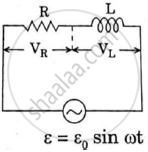
The potential difference across the resistor is 160V and that across the inductor is 120V. Find the effective value of the applied voltage. If the effective current in the circuit be 1.0 A, calculate the total impedance of the circuit.
What will be the potential difference in the circuit when direct current is passed through the circuit?
Answer the following question.
In a series LCR circuit connected across an ac source of variable frequency, obtain the expression for its impedance and draw a plot showing its variation with frequency of the ac source.
Answer the following question.
Draw the diagram of a device that is used to decrease high ac voltage into a low ac voltage and state its working principle. Write four sources of energy loss in this device.
Choose the correct answer from given options
The phase difference between the current and the voltage in series LCR circuit at resonance is
For a series LCR-circuit, the power loss at resonance is ______.
If an LCR series circuit is connected to an ac source, then at resonance the voltage across ______.
The resonant frequency of a RF oscillator is 1 MHz and its bandwidth is 10 kHz. The quality factor will be :
To reduce the resonant frequency in an LCR series circuit with a generator
In series LCR circuit, the plot of Imax vs ω is shown in figure. Find the bandwidth and mark in the figure.

A series RL circuit with R = 10 Ω and L = `(100/pi)` mH is connected to an ac source of voltage V = 141 sin (100 πt), where V is in volts and t is in seconds. Calculate
- the impedance of the circuit
- phase angle, and
- the voltage drop across the inductor.
To an ac power supply of 220 V at 50 Hz, a resistor of 20 Ω, a capacitor of reactance 25 Ω and an inductor of reactance 45 Ω are connected in series. The corresponding current in the circuit and the phase angle between the current and the voltage is respectively:
What constitutes a series LCR circuit?
