Advertisements
Advertisements
प्रश्न
Keeping the source frequency equal to the resonating frequency of the series LCR circuit, if the three elements, L, C and R are arranged in parallel, show that the total current in the parallel LCR circuit is minimum at this frequency. Obtain the current rms value in each branch of the circuit for the elements and source specified for this frequency.
Advertisements
उत्तर
An inductor (L), a capacitor (C), and a resistor (R) is connected in parallel with each other in a circuit where,
L = 5.0 H
C = 80 μF = 80 × 10−6 F
R = 40 Ω
Potential of the voltage source, V = 230 V
Impedance (Z) of the given parallel LCR circuit is given as:
`1/"Z" = sqrt(1/"R"^2 + (1/(ω"L") - ω"C")^2)`
Where,
ω = Angular frequency
At resonance, `1/(ω"L") - ω"C"` = 0
∴ ω = `1/sqrt("LC")`
= `1/(sqrt(5 xx 80 xx 10^-6))`
= 50 rad/s
Hence, the magnitude of Z is the maximum at 50 rad/s. As a result, the total current is minimum.
Rms current flowing through inductor L is given as:
IL = `"V"/(ω"L")`
= `230/(50 xx 5)`
= 0.92 A
Rms current flowing through capacitor C is given as:
IC = `"V"/(1/(ω"C")) = ω"CV"`
= 50 × 80 × 10−6 × 230
= 0.92 A
Rms current flowing through resistor R is given as:
IR = `"V"/"R"`
= `230/40`
= 5.75 A
APPEARS IN
संबंधित प्रश्न
Define 'quality factor' of resonance in a series LCR circuit. What is its SI unit?
A series LCR circuit is connected across an a.c. source of variable angular frequency 'ω'. Plot a graph showing variation of current 'i' as a function of 'ω' for two resistances R1 and R2 (R1 > R2).
Answer the following questions using this graph :
(a) In which case is the resonance sharper and why?
(b) In which case in the power dissipation more and why?
A series LCR circuit is connected to an ac source. Using the phasor diagram, derive the expression for the impedance of the circuit. Plot a graph to show the variation of current with frequency of the source, explaining the nature of its variation.
An L-R circuit has L = 1.0 H and R = 20 Ω. It is connected across an emf of 2.0 V at t = 0. Find di/dt at (a) t = 100 ms, (b) t = 200 ms and (c) t = 1.0 s.
An inductor-coil of inductance 17 mH is constructed from a copper wire of length 100 m and cross-sectional area 1 mm2. Calculate the time constant of the circuit if this inductor is joined across an ideal battery. The resistivity of copper = 1.7 × 10⁻⁸ Ω-m.
A coil having an inductance L and a resistance R is connected to a battery of emf ε. Find the time taken for the magnetic energy stored in the circuit to change from one fourth of the steady-state value to half of the steady-state value.
Using the phasor diagram, derive the expression for the current flowing in an ideal inductor connected to an a.c. source of voltage, v= vo sin ωt. Hence plot graphs showing the variation of (i) applied voltage and (ii) the current as a function of ωt.
The selectivity of a series LCR a.c. circuit is large, when ______.
Figure shows a series LCR circuit connected to a variable frequency 230 V source. L = 5.0 H, C = 80 µF, R = 40 Ω.
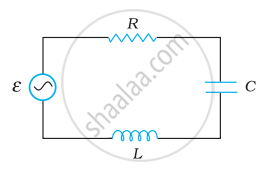
- Determine the source frequency which drives the circuit in resonance.
- Obtain the impedance of the circuit and the amplitude of current at the resonating frequency.
- Determine the rms potential drops across the three elements of the circuit. Show that the potential drop across the LC combination is zero at the resonating frequency.
In an L.C.R. series a.c. circuit, the current ______.
If an LCR series circuit is connected to an ac source, then at resonance the voltage across ______.
To reduce the resonant frequency in an LCR series circuit with a generator
A series LCR circuit containing 5.0 H inductor, 80 µF capacitor and 40 Ω resistor is connected to 230 V variable frequency ac source. The angular frequencies of the source at which power transferred to the circuit is half the power at the resonant angular frequency are likely to be ______.
If the rms current in a 50 Hz ac circuit is 5 A, the value of the current 1/300 seconds after its value becomes zero is ______.
In series LCR circuit, the plot of Imax vs ω is shown in figure. Find the bandwidth and mark in the figure.

A series LCR circuit containing a resistance of 120 Ω has angular resonance frequency 4 × 10⁵ rad s-1. At resonance the voltage across resistance and inductance are 60 V and 40 V respectively. At what frequency the current in the circuit lags the voltage by 45°. Give answer in ______ × 105 rad s-1.
A series LCR circuit is connected to an ac source. Using the phasor diagram, derive the expression for the impedance of the circuit.
Select the most appropriate option with regard to resonance in a series LCR circuit.
The net impedance of circuit (as shown in figure) will be ______.
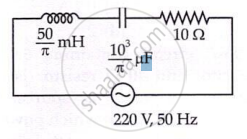
In the given circuit, rms value of current (Irms) through the resistor R is: