Advertisements
Advertisements
प्रश्न
Answer the following question.
Draw the diagram of a device that is used to decrease high ac voltage into a low ac voltage and state its working principle. Write four sources of energy loss in this device.
Advertisements
उत्तर
A transformer is a device that is used to either increase or decrease the ac voltage level. In order to decrease the high ac voltage level into a low ac voltage level we need a step-down transformer, whose diagram is as follows:

Working Principle:
A transformer works on the principle of electromagnetic induction. Alternating current in the primary coil produces a changing magnetic flux due to this an induced current is set up in the secondary coil. Losses in a transformer: Copper loss - The windings of the transformer have finite resistance due to which some energy is lost in the form of heat. It can be diminished using thick copper wires.
Iron loss - Loss is in the bulk of iron core due to the induced eddy currents in the iron core. It is minimized by using a thin laminated core.
Hysteresis loss - Alternating magnetizing and demagnetizing of the iron core causes the loss of energy in the form of heat. It is minimized using a special alloy of the iron core with silicon that has low hysteresis loss.
Magnetic loss - All the magnetic flux due to the primary coil does not pass through the secondary coil. So there is some leakage of flux. This loss can be minimized by winding primary over the secondary coil.
संबंधित प्रश्न
Define 'quality factor' of resonance in a series LCR circuit. What is its SI unit?
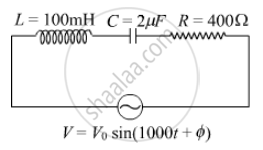
(i) Find the value of the phase difference between the current and the voltage in the series LCR circuit shown below. Which one leads in phase : current or voltage ?
(ii) Without making any other change, find the value of the additional capacitor C1, to be connected in parallel with the capacitor C, in order to make the power factor of the circuit unity.
In a series LCR circuit, obtain the condition under which the impedance of the circuit is minimum ?
A series LCR circuit is connected to a source having voltage v = vm sin ωt. Derive the expression for the instantaneous current I and its phase relationship to the applied voltage.
Obtain the condition for resonance to occur. Define ‘power factor’. State the conditions under which it is (i) maximum and (ii) minimum.
An LR circuit with emf ε is connected at t = 0. (a) Find the charge Q which flows through the battery during 0 to t. (b) Calculate the work done by the battery during this period. (c) Find the heat developed during this period. (d) Find the magnetic field energy stored in the circuit at time t. (e) Verify that the results in the three parts above are consistent with energy conservation.
A constant current exists in an inductor-coil connected to a battery. The coil is short-circuited and the battery is removed. Show that the charge flown through the coil after the short-circuiting is the same as that which flows in one time constant before the short-circuiting.
What will be the potential difference in the circuit when direct current is passed through the circuit?
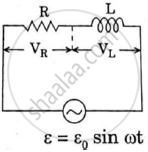
A series LCR circuit containing 5.0 H inductor, 80 µF capacitor and 40 Ω resistor is connected to 230 V variable frequency ac source. The angular frequencies of the source at which power transferred to the circuit is half the power at the resonant angular frequency are likely to be ______.
In series LCR circuit, the plot of Imax vs ω is shown in figure. Find the bandwidth and mark in the figure.

A series LCR circuit is connected to an ac source. Using the phasor diagram, derive the expression for the impedance of the circuit.
