Advertisements
Advertisements
प्रश्न
An inductor-coil of resistance 10 Ω and inductance 120 mH is connected across a battery of emf 6 V and internal resistance 2 Ω. Find the charge which flows through the inductor in (a) 10 ms, (b) 20 ms and (c) 100 ms after the connections are made.
Advertisements
उत्तर
Given:-
Inductance, L = 120 mH = 0.120 H
Resistance, R = 10 Ω
Emf of the battery, E = 6 V
Internal resistance of the battery, r = 2 Ω
The current at any instant in the LR circuit is given by
i = i0(1 − e−t/τ)
Charge dQ flown in time dt is given by
dQ = idt = i0(1 − e−t/τ)dt
Q = ∫ dQ
\[= \int\limits_0^t i_0 = \int\limits_0^t i_0 (1 - e^{- t/\tau} )dt\]
\[ = i_0 \left[ \int\limits_0^t dt - \int\limits_0^t e^{- t/\tau} dt \right]\]
\[ = i_0 \left[ t - \left\{ \left( - \tau \right) \left| e^{- t/\tau} \right|^t_0 \right\} \right]\]
\[ = i_0 \left[ t + \tau\left\{ e^{- t/\tau} - 1 \right\} \right]\]
The steady-state current and the time constant for the given circuit are as follows:-
\[i_0 = \frac{E}{R_{total}} = \frac{6}{10 + 2} = \frac{6}{12} = 0 . 5 A\]
\[\tau = \frac{L}{R} = \frac{120}{12} = 0 . 01 s\]
Now,
(a) At time t = 0.01 s,
Q = 0.5 [0.01 + 0.01(e−0.1/0.01 − 0.01)]
= 0.00108 = 1.8 × 10−3 = 1.8 mΩ
(b) At t = 20 ms = 2 × 10⁻² s = 0.02 s,
Q = 0.5 [0.02 + 0.01(e−0.02/0.01 − 0.01)]
= 0.005676 = 5.7 × 10⁻³ C
= 5.7 mC
(c) At t = 100 ms = 0.1 s,
Q = 0.5 [0.1 + 0.1 (e−0.1/0.01 − 0.01)]
= 0.045 C = 45 mc
APPEARS IN
संबंधित प्रश्न
In a series LCR circuit, obtain the condition under which watt-less current flows in the circuit ?
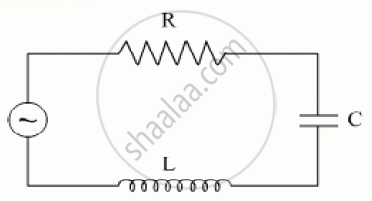
The figure shows a series LCR circuit with L = 10.0 H, C = 40 μF, R = 60 Ω connected to a variable frequency 240 V source, calculate
(i) the angular frequency of the source which drives the circuit at resonance,
(ii) the current at the resonating frequency,
(iii) the rms potential drop across the inductor at resonance.
A coil of resistance 40 Ω is connected across a 4.0 V battery. 0.10 s after the battery is connected, the current in the coil is 63 mA. Find the inductance of the coil.
The time constant of an LR circuit is 40 ms. The circuit is connected at t = 0 and the steady-state current is found to be 2.0 A. Find the current at (a) t = 10 ms (b) t = 20 ms, (c) t = 100 ms and (d) t = 1 s.
An LR circuit contains an inductor of 500 mH, a resistor of 25.0 Ω and an emf of 5.00 V in series. Find the potential difference across the resistor at t = (a) 20.0 ms, (b) 100 ms and (c) 1.00 s.
A solenoid having inductance 4.0 H and resistance 10 Ω is connected to a 4.0 V battery at t = 0. Find (a) the time constant, (b) the time elapsed before the current reaches 0.63 of its steady-state value, (c) the power delivered by the battery at this instant and (d) the power dissipated in Joule heating at this instant.
The magnetic field at a point inside a 2.0 mH inductor-coil becomes 0.80 of its maximum value in 20 µs when the inductor is joined to a battery. Find the resistance of the circuit.
What will be the potential difference in the circuit when direct current is passed through the circuit?
Draw a labelled graph showing a variation of impedance of a series LCR circuit with frequency of the a.c. supply.
Choose the correct answer from given options
The phase difference between the current and the voltage in series LCR circuit at resonance is
A series LCR circuit with L = 0.12 H, C = 480 nF, R = 23 Ω is connected to a 230 V variable frequency supply.
(a) What is the source frequency for which current amplitude is maximum. Obtain this maximum value.
(b) What is the source frequency for which average power absorbed by the circuit is maximum. Obtain the value of this maximum power.
(c) For which frequencies of the source is the power transferred to the circuit half the power at resonant frequency? What is the current amplitude at these frequencies?
(d) What is the Q-factor of the given circuit?
If an LCR series circuit is connected to an ac source, then at resonance the voltage across ______.
In series LCR circuit, the phase angle between supply voltage and current is ______.
Which of the following components of an LCR circuit, with a.c. supply, dissipates energy?
A series LCR circuit containing a 5.0 H inductor, 80 µF capacitors, and 40 Ω resistor is connected to a 230 V variable frequency ac source. The angular frequencies of the source at which power is transferred to the circuit are half the power at the resonant angular frequency are likely to be ______.
As the frequency of an ac circuit increases, the current first increases and then decreases. What combination of circuit elements is most likely to comprise the circuit?
- Inductor and capacitor.
- Resistor and inductor.
- Resistor and capacitor.
- Resistor, inductor and capacitor.
For an LCR circuit driven at frequency ω, the equation reads
`L (di)/(dt) + Ri + q/C = v_i = v_m` sin ωt
- Multiply the equation by i and simplify where possible.
- Interpret each term physically.
- Cast the equation in the form of a conservation of energy statement.
- Integrate the equation over one cycle to find that the phase difference between v and i must be acute.
A series LCR circuit driven by 300 V at a frequency of 50 Hz contains a resistance R = 3 kΩ, an inductor of inductive reactance XL = 250 πΩ, and an unknown capacitor. The value of capacitance to maximize the average power should be ______.
A series LCR circuit is connected to an ac source. Using the phasor diagram, derive the expression for the impedance of the circuit.
