Advertisements
Advertisements
Question
An inductor-coil of resistance 10 Ω and inductance 120 mH is connected across a battery of emf 6 V and internal resistance 2 Ω. Find the charge which flows through the inductor in (a) 10 ms, (b) 20 ms and (c) 100 ms after the connections are made.
Advertisements
Solution
Given:-
Inductance, L = 120 mH = 0.120 H
Resistance, R = 10 Ω
Emf of the battery, E = 6 V
Internal resistance of the battery, r = 2 Ω
The current at any instant in the LR circuit is given by
i = i0(1 − e−t/τ)
Charge dQ flown in time dt is given by
dQ = idt = i0(1 − e−t/τ)dt
Q = ∫ dQ
\[= \int\limits_0^t i_0 = \int\limits_0^t i_0 (1 - e^{- t/\tau} )dt\]
\[ = i_0 \left[ \int\limits_0^t dt - \int\limits_0^t e^{- t/\tau} dt \right]\]
\[ = i_0 \left[ t - \left\{ \left( - \tau \right) \left| e^{- t/\tau} \right|^t_0 \right\} \right]\]
\[ = i_0 \left[ t + \tau\left\{ e^{- t/\tau} - 1 \right\} \right]\]
The steady-state current and the time constant for the given circuit are as follows:-
\[i_0 = \frac{E}{R_{total}} = \frac{6}{10 + 2} = \frac{6}{12} = 0 . 5 A\]
\[\tau = \frac{L}{R} = \frac{120}{12} = 0 . 01 s\]
Now,
(a) At time t = 0.01 s,
Q = 0.5 [0.01 + 0.01(e−0.1/0.01 − 0.01)]
= 0.00108 = 1.8 × 10−3 = 1.8 mΩ
(b) At t = 20 ms = 2 × 10⁻² s = 0.02 s,
Q = 0.5 [0.02 + 0.01(e−0.02/0.01 − 0.01)]
= 0.005676 = 5.7 × 10⁻³ C
= 5.7 mC
(c) At t = 100 ms = 0.1 s,
Q = 0.5 [0.1 + 0.1 (e−0.1/0.01 − 0.01)]
= 0.045 C = 45 mc
APPEARS IN
RELATED QUESTIONS
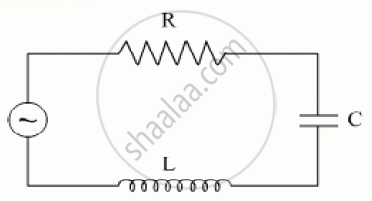
The figure shows a series LCR circuit with L = 10.0 H, C = 40 μF, R = 60 Ω connected to a variable frequency 240 V source, calculate
(i) the angular frequency of the source which drives the circuit at resonance,
(ii) the current at the resonating frequency,
(iii) the rms potential drop across the inductor at resonance.
A series LCR circuit is connected to an ac source. Using the phasor diagram, derive the expression for the impedance of the circuit. Plot a graph to show the variation of current with frequency of the source, explaining the nature of its variation.
An L-R circuit has L = 1.0 H and R = 20 Ω. It is connected across an emf of 2.0 V at t = 0. Find di/dt at (a) t = 100 ms, (b) t = 200 ms and (c) t = 1.0 s.
An LR circuit with emf ε is connected at t = 0. (a) Find the charge Q which flows through the battery during 0 to t. (b) Calculate the work done by the battery during this period. (c) Find the heat developed during this period. (d) Find the magnetic field energy stored in the circuit at time t. (e) Verify that the results in the three parts above are consistent with energy conservation.
The current in a discharging LR circuit without the battery drops from 2.0 A to 1.0 A in 0.10 s. (a) Find the time constant of the circuit. (b) If the inductance of the circuit 4.0 H, what is its resistance?
(i) An a.c. source of emf ε = 200 sin omegat is connected to a resistor of 50 Ω . calculate :
(1) Average current (`"I"_("avg")`)
(2) Root mean square (rms) value of emf
(ii) State any two characteristics of resonance in an LCR series circuit.
An ac circuit as shown in the figure has an inductor of inductance L and a resistor or resistance R connected in series. Using the phasor diagram, explain why the voltage in the circuit will lead the current in phase.
In a series, LCR circuit, obtain an expression for the resonant frequency.
Draw a labelled graph showing a variation of impedance of a series LCR circuit with frequency of the a.c. supply.
Use the expression for Lorentz force acting on the charge carriers of a conductor to obtain the expression for the induced emf across the conductor of length l moving with velocity v through a magnetic field B acting perpendicular to its length.
A coil of 40 henry inductance is connected in series with a resistance of 8 ohm and the combination is joined to the terminals of a 2 volt battery. The time constant of the circuit is ______.
In a series LCR circuit the voltage across an inductor, capacitor and resistor are 20 V, 20 V and 40 V respectively. The phase difference between the applied voltage and the current in the circuit is ______.
In series LCR AC-circuit, the phase angle between current and voltage is
To reduce the resonant frequency in an LCR series circuit with a generator ______.
A coil of 0.01 henry inductance and 1 ohm resistance is connected to 200 volt, 50 Hz ac supply. Find the impedance of the circuit and time lag between max. alternating voltage and current.
For an LCR circuit driven at frequency ω, the equation reads
`L (di)/(dt) + Ri + q/C = v_i = v_m` sin ωt
- Multiply the equation by i and simplify where possible.
- Interpret each term physically.
- Cast the equation in the form of a conservation of energy statement.
- Integrate the equation over one cycle to find that the phase difference between v and i must be acute.
A series RL circuit with R = 10 Ω and L = `(100/pi)` mH is connected to an ac source of voltage V = 141 sin (100 πt), where V is in volts and t is in seconds. Calculate
- the impedance of the circuit
- phase angle, and
- the voltage drop across the inductor.
To an ac power supply of 220 V at 50 Hz, a resistor of 20 Ω, a capacitor of reactance 25 Ω and an inductor of reactance 45 Ω are connected in series. The corresponding current in the circuit and the phase angle between the current and the voltage is respectively:
Out of the following which one is NOT the characteristic of LCR series resonant circuit?
Which circuit equation results from applying Kirchhoff's Voltage Law around the series LCR loop?
