Advertisements
Advertisements
Question
An LR circuit contains an inductor of 500 mH, a resistor of 25.0 Ω and an emf of 5.00 V in series. Find the potential difference across the resistor at t = (a) 20.0 ms, (b) 100 ms and (c) 1.00 s.
Advertisements
Solution
Given:-
Inductance of the inductor, L = 500 mH
Resistance of the resistor connected, R = 25 Ω
Emf of the battery, E = 5 V
For the given circuit, the potential difference across the resistance is given by
V = iR
The current in the LR circuit at time t is given by
i = i0 (1 − e−tR/L)
∴ Potential difference across the resistance at time t, V = (i0(1 − e−tR/L)R
(a) For t = 20 ms,
i = i0(1 − e−tR/L)
\[= \frac{E}{R}(1 - e^{- tR/L} )\]
\[ = \frac{5}{25}(1 - e^{- (2 \times {10}^{- 3} \times 25)/(500 \times {10}^{- 3} )} \]
\[ = \frac{1}{5}(1 - e^{- 1} ) = \frac{1}{5}(1 - 0 . 3678)\]
\[ = \frac{0 . 632}{5} = 0 . 1264 A\]
Potential difference:-
V = iR = (0.1264) × (25)
= 3.1606 V = 3.16 V
(b) For t = 100 ms,
i = i0(1 − e−tR/L)
\[= \frac{5}{25}\left( 1 - e^{( - 100 \times {10}^{- 3} ) \times (25/500 \times {10}^{- 3} )} \right)\]
\[ = \frac{1}{5}(1 - e^{- 50} )\]
\[ = \frac{1}{5}(1 - 0 . 0067)\]
\[ = \frac{0 . 9932}{5} = 0 . 19864 A\]
Potential difference:-
V = iR
= (0.19864) × (25) = 4.9665 = 4.97 V
(c) For t = 1 s,
\[i = \frac{5}{25}\left( 1 - e^{- 1 \times 25/500 \times {10}^{- 3}} \right)\]
\[ = \frac{1}{5}(1 - e^{- 50} )\]
\[ = \frac{1}{5} \times 1 = \frac{1}{5} A\]
Potential difference:-
V = iR
\[= \left( \frac{1}{5} \times 25 \right) = 5 V\]
APPEARS IN
RELATED QUESTIONS
In a series LCR circuit connected to an a.c. source of voltage v = vmsinωt, use phasor diagram to derive an expression for the current in the circuit. Hence, obtain the expression for the power dissipated in the circuit. Show that power dissipated at resonance is maximum
A series LCR circuit is connected to an ac source. Using the phasor diagram, derive the expression for the impedance of the circuit. Plot a graph to show the variation of current with frequency of the source, explaining the nature of its variation.
Show that in an a.c. circuit containing a pure inductor, the voltage is ahead of current by π/2 in phase ?
The time constant of an LR circuit is 40 ms. The circuit is connected at t = 0 and the steady-state current is found to be 2.0 A. Find the current at (a) t = 10 ms (b) t = 20 ms, (c) t = 100 ms and (d) t = 1 s.
An inductor-coil of inductance 17 mH is constructed from a copper wire of length 100 m and cross-sectional area 1 mm2. Calculate the time constant of the circuit if this inductor is joined across an ideal battery. The resistivity of copper = 1.7 × 10⁻⁸ Ω-m.
The magnetic field at a point inside a 2.0 mH inductor-coil becomes 0.80 of its maximum value in 20 µs when the inductor is joined to a battery. Find the resistance of the circuit.
Use the expression for Lorentz force acting on the charge carriers of a conductor to obtain the expression for the induced emf across the conductor of length l moving with velocity v through a magnetic field B acting perpendicular to its length.
A series LCR circuit with R = 20 Ω, L = 1.5 H and C = 35 µF is connected to a variable-frequency 200 V ac supply. When the frequency of the supply equals the natural frequency of the circuit, what is the average power transferred to the circuit in one complete cycle?
Obtain the resonant frequency and Q-factor of a series LCR circuit with L = 3.0 H, C = 27 µF, and R = 7.4 Ω. It is desired to improve the sharpness of the resonance of the circuit by reducing its ‘full width at half maximum’ by a factor of 2. Suggest a suitable way.
If an LCR series circuit is connected to an ac source, then at resonance the voltage across ______.
In an LCR series a.c. circuit, the voltage across each of the components, L, C and R is 50V. The voltage across the LC combination will be ______.
In series LCR AC-circuit, the phase angle between current and voltage is
A series LCR circuit containing 5.0 H inductor, 80 µF capacitor and 40 Ω resistor is connected to 230 V variable frequency ac source. The angular frequencies of the source at which power transferred to the circuit is half the power at the resonant angular frequency are likely to be ______.
Consider the LCR circuit shown in figure. Find the net current i and the phase of i. Show that i = v/Z`. Find the impedance Z for this circuit.

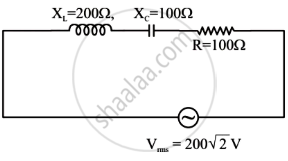
In the given circuit, rms value of current (Irms) through the resistor R is:
When a capacitor is connected in series LR circuit, the alternating current flowing in the circuit ______
What constitutes a series LCR circuit?
Which expression gives the sinusoidally varying voltage applied by the AC source?
