Advertisements
Advertisements
प्रश्न
A series RL circuit with R = 10 Ω and L = `(100/pi)` mH is connected to an ac source of voltage V = 141 sin (100 πt), where V is in volts and t is in seconds. Calculate
- the impedance of the circuit
- phase angle, and
- the voltage drop across the inductor.
Advertisements
उत्तर
Given:
R = 10 Ω
L = `(100/pi)` mH
V = 141 sin (100 π)t
From this equation, we get the value of ω = 100π and V = 141 volt
- To find: Impedance (Z)
Z = `sqrt(R^2 + X_L^2)`
Where Z is the impedance, R is the resistance, and XL is the impedance,
XL = ωL
XL = `(100pi xx 100)/(pi xx 10^-3)`
XL = 10Ω
Z = `sqrt(R^2 + X_L^2)`
Z = `sqrt((10)^2 + (10)^2)`
Z = `sqrt200`
Z = `10sqrt2`Ω - Phase Angle (Φ):
We can calculate the phase angle by the following formula,
`cosphi = R/Z`
`cosphi = 10/(10sqrt2)`
`cosphi = 1/sqrt2`
`phi = 45^circ` - Voltage drop:
`V_L = IX_L`
= `V/Z xx X_L`
`V_L = 141/(10sqrt2) xx 10`
`V_L = 141/sqrt2`
`V_L ≅ 100` volt
APPEARS IN
संबंधित प्रश्न
The time constant of an LR circuit is 40 ms. The circuit is connected at t = 0 and the steady-state current is found to be 2.0 A. Find the current at (a) t = 10 ms (b) t = 20 ms, (c) t = 100 ms and (d) t = 1 s.
An inductor-coil of inductance 17 mH is constructed from a copper wire of length 100 m and cross-sectional area 1 mm2. Calculate the time constant of the circuit if this inductor is joined across an ideal battery. The resistivity of copper = 1.7 × 10⁻⁸ Ω-m.
Answer the following question.
In a series LCR circuit connected across an ac source of variable frequency, obtain the expression for its impedance and draw a plot showing its variation with frequency of the ac source.
Figure shows a series LCR circuit connected to a variable frequency 230 V source. L = 5.0 H, C = 80 µF, R = 40 Ω.
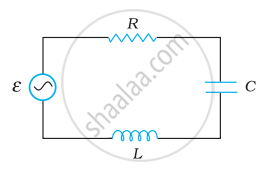
- Determine the source frequency which drives the circuit in resonance.
- Obtain the impedance of the circuit and the amplitude of current at the resonating frequency.
- Determine the rms potential drops across the three elements of the circuit. Show that the potential drop across the LC combination is zero at the resonating frequency.
A coil of 40 henry inductance is connected in series with a resistance of 8 ohm and the combination is joined to the terminals of a 2 volt battery. The time constant of the circuit is ______.
In an LCR circuit having L = 8 henery. C = 0.5 µF and R = 100 ohm in series, the resonance frequency in radian/sec is
A coil of 0.01 henry inductance and 1 ohm resistance is connected to 200 volt, 50 Hz ac supply. Find the impedance of the circuit and time lag between max. alternating voltage and current.
A series LCR circuit containing a resistance of 120 Ω has angular resonance frequency 4 × 10⁵ rad s-1. At resonance the voltage across resistance and inductance are 60 V and 40 V respectively. At what frequency the current in the circuit lags the voltage by 45°. Give answer in ______ × 105 rad s-1.
To reduce the resonant frequency in an L-C-R series circuit with a generator ______.
When a capacitor is connected in series LR circuit, the alternating current flowing in the circuit ______
