Advertisements
Advertisements
प्रश्न
A coil having an inductance L and a resistance R is connected to a battery of emf ε. Find the time taken for the magnetic energy stored in the circuit to change from one fourth of the steady-state value to half of the steady-state value.
Advertisements
उत्तर
Given:-
Emf of the battery = ε
Inductance of the inductor = L
Resistance = R
Maximum current in the coil `= epsilon/R`
At the steady state, current in the coil, `i =epsilon/R.`
The magnetic field energy stored at the steady state is given by
\[U = \frac{1}{2}L i^2\text{ or } U\]
\[= \frac{\epsilon^2}{2 R^2}L\]
One-fourth of the steady-state value of the magnetic energy is given by
\[U' = \frac{1}{8}L\frac{E^2}{R^2}\]
Half of the value of the steady-state energy \[=\frac{1}{4}L\frac{E^2}{R^2}\]
Let the magnetic energy reach one-fourth of its steady-state value in time t1 and let it reach half of its value in time t2.
Now,
\[\frac{1}{8}L\frac{E^2}{R^2} = \frac{1}{2}L\frac{E^2}{R^2}(1 - e^{- t_1 R/L} )^2 \]
\[ \Rightarrow 1 - e^{- t_1 R/L} = \frac{1}{2}\]
\[ \Rightarrow t_1 \frac{R}{L} = \ln 2\]
And,
\[\frac{1}{4}L\frac{E^2}{R^2} = \frac{1}{2}L\frac{E^2}{R^2}(1 - e^{- t_2 R/L} )^2 \]
\[ \Rightarrow e^{- t_2 R/L} = \frac{\sqrt{2} - 1}{\sqrt{2}} = \frac{2 - \sqrt{2}}{2}\]
\[ \Rightarrow t_1 = \tau \ln\left( \frac{1}{2 - \sqrt{2}} \right) + \ln 2\]
Thus, the time taken by the magnetic energy stored in the circuit to change from one-fourth of its steady-state value to half of its steady-state value is given by
\[t_2 - t_1 = \tau \ln\frac{1}{2 - \sqrt{2}}\]
APPEARS IN
संबंधित प्रश्न
Why does current in a steady state not flow in a capacitor connected across a battery? However momentary current does flow during charging or discharging of the capacitor. Explain.
(i) Find the value of the phase difference between the current and the voltage in the series LCR circuit shown below. Which one leads in phase : current or voltage ?
(ii) Without making any other change, find the value of the additional capacitor C1, to be connected in parallel with the capacitor C, in order to make the power factor of the circuit unity.
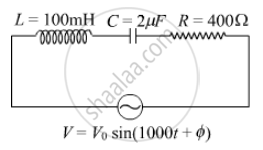
In a series LCR circuit, obtain the condition under which the impedance of the circuit is minimum ?
Derive an expression for the average power consumed in a series LCR circuit connected to a.c. source in which the phase difference between the voltage and the current in the circuit is Φ.
Find the value of t/τ for which the current in an LR circuit builds up to (a) 90%, (b) 99% and (c) 99.9% of the steady-state value.
A solenoid having inductance 4.0 H and resistance 10 Ω is connected to a 4.0 V battery at t = 0. Find (a) the time constant, (b) the time elapsed before the current reaches 0.63 of its steady-state value, (c) the power delivered by the battery at this instant and (d) the power dissipated in Joule heating at this instant.
Two coils A and B have inductances 1.0 H and 2.0 H respectively. The resistance of each coil is 10 Ω. Each coil is connected to an ideal battery of emf 2.0 V at t = 0. Let iA and iBbe the currents in the two circuit at time t. Find the ratio iA / iB at (a) t = 100 ms, (b) t = 200 ms and (c) t = 1 s.
The potential difference across the resistor is 160V and that across the inductor is 120V. Find the effective value of the applied voltage. If the effective current in the circuit be 1.0 A, calculate the total impedance of the circuit.
In a series, LCR circuit, obtain an expression for the resonant frequency.
To reduce the resonant frequency in an LCR series circuit with a generator ______.
A coil of 0.01 henry inductance and 1 ohm resistance is connected to 200 volt, 50 Hz ac supply. Find the impedance of the circuit and time lag between max. alternating voltage and current.
For an LCR circuit driven at frequency ω, the equation reads
`L (di)/(dt) + Ri + q/C = v_i = v_m` sin ωt
- Multiply the equation by i and simplify where possible.
- Interpret each term physically.
- Cast the equation in the form of a conservation of energy statement.
- Integrate the equation over one cycle to find that the phase difference between v and i must be acute.
A series LCR circuit containing a resistance of 120 Ω has angular resonance frequency 4 × 10⁵ rad s-1. At resonance the voltage across resistance and inductance are 60 V and 40 V respectively. At what frequency the current in the circuit lags the voltage by 45°. Give answer in ______ × 105 rad s-1.
A series RL circuit with R = 10 Ω and L = `(100/pi)` mH is connected to an ac source of voltage V = 141 sin (100 πt), where V is in volts and t is in seconds. Calculate
- the impedance of the circuit
- phase angle, and
- the voltage drop across the inductor.
Draw the phasor diagram for a series LRC circuit connected to an AC source.
When an alternating voltage of 220V is applied across device X, a current of 0.25A flows which lags behind the applied voltage in phase by π/2 radian. If the same voltage is applied across another device Y, the same current flows but now it is in phase with the applied voltage.
- Name the devices X and Y.
- Calculate the current flowing in the circuit when the same voltage is applied across the series combination of X and Y.
Draw the impedance triangle for a series LCR AC circuit and write the expressions for the impedance and the phase difference between the emf and the current.
Select the most appropriate option with regard to resonance in a series LCR circuit.
Draw a labelled graph showing variation of impedance (Z) of a series LCR circuit Vs frequency (f) of the ac supply. Mark the resonant frequency as f0·
What constitutes a series LCR circuit?
