Advertisements
Advertisements
प्रश्न
In a series, LCR circuit, obtain an expression for the resonant frequency.
Derive an expression for resonant frequency of series resonant circuit.
Advertisements
उत्तर
In a series LCR circuit,
I = `E/sqrt(R^2+(omega L - 1/(omega c))^2`
From this equation, we may observe that when ω = 0, I becomes 0, and again when ω = ∞, I = 0.
∴ This implies there must be a value of ω at which I is maximum.
So when I is maximum, `sqrt(R^2 + (omega L - 1/(omega c))^2` is minimum.
For this either R = 0, or `omega L - 1/(omega c)` = 0
So when `omega L -1/(omega c)` = 0, this is called the resonance condition.
∴ At resonance,
ωL = `1/(omega c)`
⇒ ω2 = `1/(L c)`
⇒ ωr = `1/sqrt(L c)`
⇒ 2 π fr = `1/sqrt(L c)`
∴ Frequency of resonance (fr) = `1/(2 pi) * 1/sqrt(L c)`
i.e., fr = `1/(2 pi) * 1/sqrt(L c)`
This is the required expression for resonant frequency.
संबंधित प्रश्न
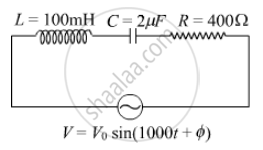
(i) Find the value of the phase difference between the current and the voltage in the series LCR circuit shown below. Which one leads in phase : current or voltage ?
(ii) Without making any other change, find the value of the additional capacitor C1, to be connected in parallel with the capacitor C, in order to make the power factor of the circuit unity.
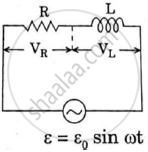
A source of ac voltage v = v0 sin ωt, is connected across a pure inductor of inductance L. Derive the expressions for the instantaneous current in the circuit. Show that average power dissipated in the circuit is zero.
Derive an expression for the average power consumed in a series LCR circuit connected to a.c. source in which the phase difference between the voltage and the current in the circuit is Φ.
A coil of resistance 40 Ω is connected across a 4.0 V battery. 0.10 s after the battery is connected, the current in the coil is 63 mA. Find the inductance of the coil.
An L-R circuit has L = 1.0 H and R = 20 Ω. It is connected across an emf of 2.0 V at t = 0. Find di/dt at (a) t = 100 ms, (b) t = 200 ms and (c) t = 1.0 s.
An inductor-coil of inductance 17 mH is constructed from a copper wire of length 100 m and cross-sectional area 1 mm2. Calculate the time constant of the circuit if this inductor is joined across an ideal battery. The resistivity of copper = 1.7 × 10⁻⁸ Ω-m.
An LR circuit with emf ε is connected at t = 0. (a) Find the charge Q which flows through the battery during 0 to t. (b) Calculate the work done by the battery during this period. (c) Find the heat developed during this period. (d) Find the magnetic field energy stored in the circuit at time t. (e) Verify that the results in the three parts above are consistent with energy conservation.
What will be the potential difference in the circuit when direct current is passed through the circuit?
Draw a labelled graph showing a variation of impedance of a series LCR circuit with frequency of the a.c. supply.
Derive an expression for the average power dissipated in a series LCR circuit.
The selectivity of a series LCR a.c. circuit is large, when ______.
Figure shows a series LCR circuit connected to a variable frequency 230 V source. L = 5.0 H, C = 80 µF, R = 40 Ω.
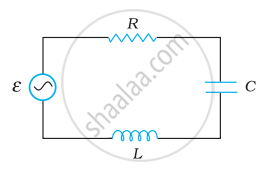
- Determine the source frequency which drives the circuit in resonance.
- Obtain the impedance of the circuit and the amplitude of current at the resonating frequency.
- Determine the rms potential drops across the three elements of the circuit. Show that the potential drop across the LC combination is zero at the resonating frequency.
In an L.C.R. series a.c. circuit, the current ______.
In series combination of R, L and C with an A.C. source at resonance, if R = 20 ohm, then impedence Z of the combination is ______.
Assertion: When the frequency of the AC source in an LCR circuit equals the resonant frequency, the reactance of the circuit is zero, and so there is no current through the inductor or the capacitor.
Reason: The net current in the inductor and capacitor is zero.
A coil of 40 henry inductance is connected in series with a resistance of 8 ohm and the combination is joined to the terminals of a 2 volt battery. The time constant of the circuit is ______.
A series LCR circuit contains inductance 5 mH, capacitance 2µF and resistance ion. If a frequency A.C. source is varied, what is the frequency at which maximum power is dissipated?
To reduce the resonant frequency in an LCR series circuit with a generator
In an LCR circuit having L = 8 henery. C = 0.5 µF and R = 100 ohm in series, the resonance frequency in radian/sec is
Which of the following components of an LCR circuit, with a.c. supply, dissipates energy?
Draw the phasor diagram for a series LRC circuit connected to an AC source.
A series LCR circuit is connected to an ac source. Using the phasor diagram, derive the expression for the impedance of the circuit.
Select the most appropriate option with regard to resonance in a series LCR circuit.
A series LCR circuit (L = 10 H, C = 10 µF, R = 50 Ω) is connected to V = 200 sin (100t). If ν0 is the resonant frequency and ν is the source frequency, then ______.
Which of the following combinations should be selected for better tuning of an L-C-R circuit used for communication?
To an ac power supply of 220 V at 50 Hz, a resistor of 20 Ω, a capacitor of reactance 25 Ω and an inductor of reactance 45 Ω are connected in series. The corresponding current in the circuit and the phase angle between the current and the voltage is respectively:
Which circuit equation results from applying Kirchhoff's Voltage Law around the series LCR loop?
