Advertisements
Advertisements
प्रश्न
An LR circuit with emf ε is connected at t = 0. (a) Find the charge Q which flows through the battery during 0 to t. (b) Calculate the work done by the battery during this period. (c) Find the heat developed during this period. (d) Find the magnetic field energy stored in the circuit at time t. (e) Verify that the results in the three parts above are consistent with energy conservation.
Advertisements
उत्तर
(a) Let the current in the LR circuit be i.
Let the charge flowing through the coil in the infinitesimal time dt be dq.
Now,
\[i = \frac{dq}{dt}\]
∴ dq = idt
The current in the LR circuit after t seconds after connecting the battery is given by
i = i0 (1 − e−t/τ)
Here,
i0 = Steady state current
τ = Time constant = `L/R`
dq = i0 (1 − e−tR/L) dt
On integrating both sides, we get
\[Q = \int\limits_0^t dq\]
\[= i_0 \left[ \int\limits_0^t dt - \int\limits_0^t e^{- tR/L} dt \right]\]
\[ = i_0 \left[ t - \left( - \frac{L}{R} \right)( e^{- tR/L} - 1) \right]\]
\[ = i_0 \left[ t - \frac{L}{R}(1 - e^{- tR/L} ) \right]\]
Thus, the charge flowing in the coil in time t is given by
\[Q = \frac{\epsilon}{R}\left[ t - \frac{L}{R}(1 - e^{- tR/L} ) \right]\]
Where `i_0=epsilon/R`
(b) The work done by the battery is given by
W = εQ
From the above expression for the charge in the LR circuit, we have
\[W = \frac{\epsilon^2}{R}\left[ t - \frac{L}{R}(1 - e^{- tR/L} ) \right]\]
(c) The heat developed in time t can be calculated as follows:-
\[H = \int\limits_0^t i^2 Rdt\]
\[H = \frac{\epsilon^2}{R^2}R \int\limits_0^t (1 - e^{- tR/L} )^2 dt\]
\[H = \frac{\epsilon^2}{R} \int\limits_0^t \left[ (1 + e^{- 2tR/L} ) - 2 e^{- tR/L} \right]dt\]
\[H = \frac{\epsilon^2}{R} \left( t - \frac{L}{2R} e^{- 2tR/L} + \frac{L}{R}2 e^{- tR/L} \right)_0^t \]
\[H = \frac{\epsilon^2}{R}\left( t - \frac{L}{2R} e^{- 2tR/L} + \frac{L}{R}2 e^{- tR/L} \right) - \left( - \frac{L}{2R} + \frac{2L}{R} \right)\]
\[ = \frac{\epsilon^2}{R}\left\{ t - \frac{L}{2R}( x^2 - 4x + 3) \right\}...........\left(x = e^{- tR/L}\right)\]
(d) The magnetic energy stored in the circuit is given by
\[U = \frac{1}{2}L i^2 \]
\[ \Rightarrow U = \frac{1}{2}L\frac{\epsilon^2}{R^2} \left(1 - e^{- tR/L}\right)^2 \]
\[\Rightarrow U = \frac{L \epsilon^2}{2 R^2}(1 - x )^2\]
(e) Taking the sum of total energy stored in the magnetic field and the heat developed in time t
\[E = \frac{L \epsilon^2}{2 R^2}\left(1 - x\right)^2 + \frac{\epsilon^2}{R}\left\{ t - \frac{L}{2R}\left(x^2 - 4x + 3\right) \right\}\]
\[E = \frac{L \epsilon^2}{2 R^2}\left(1 + x^2 - 2x\right) + \frac{\epsilon^2}{R}t - \frac{L \epsilon^2}{2 R^2}\left(x^2 - 4x + 3\right)\]
\[E = \frac{L \epsilon^2}{2 R^2}\left(2x - 2\right) + \frac{\epsilon^2}{R}t\]
\[E = \frac{L \epsilon^2}{R^2}\left(x - 1\right) + \frac{\epsilon^2}{R}t\]
\[E = \frac{\epsilon^2}{R}\left\{ t - \frac{L}{R}\left(1 - x\right) \right\} = \frac{\epsilon^2}{R}\left\{ t - \frac{L}{R}\left(1 - e^{- tR/L}\right) \right\}\]
The above expression is equal to the energy drawn from the battery. Therefore, the conservation of energy holds good.
APPEARS IN
संबंधित प्रश्न
A source of ac voltage v = v0 sin ωt, is connected across a pure inductor of inductance L. Derive the expressions for the instantaneous current in the circuit. Show that average power dissipated in the circuit is zero.
In a series LCR circuit, obtain the condition under which the impedance of the circuit is minimum ?
In a series LCR circuit, obtain the condition under which watt-less current flows in the circuit ?
The time constant of an LR circuit is 40 ms. The circuit is connected at t = 0 and the steady-state current is found to be 2.0 A. Find the current at (a) t = 10 ms (b) t = 20 ms, (c) t = 100 ms and (d) t = 1 s.
An inductor-coil of inductance 17 mH is constructed from a copper wire of length 100 m and cross-sectional area 1 mm2. Calculate the time constant of the circuit if this inductor is joined across an ideal battery. The resistivity of copper = 1.7 × 10⁻⁸ Ω-m.
A solenoid having inductance 4.0 H and resistance 10 Ω is connected to a 4.0 V battery at t = 0. Find (a) the time constant, (b) the time elapsed before the current reaches 0.63 of its steady-state value, (c) the power delivered by the battery at this instant and (d) the power dissipated in Joule heating at this instant.
A constant current exists in an inductor-coil connected to a battery. The coil is short-circuited and the battery is removed. Show that the charge flown through the coil after the short-circuiting is the same as that which flows in one time constant before the short-circuiting.
In a series, LCR circuit, obtain an expression for the resonant frequency.
Figure shows a series LCR circuit connected to a variable frequency 230 V source. L = 5.0 H, C = 80 µF, R = 40 Ω.
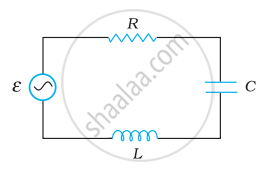
- Determine the source frequency which drives the circuit in resonance.
- Obtain the impedance of the circuit and the amplitude of current at the resonating frequency.
- Determine the rms potential drops across the three elements of the circuit. Show that the potential drop across the LC combination is zero at the resonating frequency.
A coil of 40 henry inductance is connected in series with a resistance of 8 ohm and the combination is joined to the terminals of a 2 volt battery. The time constant of the circuit is ______.
The resonant frequency of a RF oscillator is 1 MHz and its bandwidth is 10 kHz. The quality factor will be :
To reduce the resonant frequency in an LCR series circuit with a generator
In series LCR AC-circuit, the phase angle between current and voltage is
Which of the following components of an LCR circuit, with a.c. supply, dissipates energy?
A series LCR circuit containing a resistance of 120 Ω has angular resonance frequency 4 × 10⁵ rad s-1. At resonance the voltage across resistance and inductance are 60 V and 40 V respectively. At what frequency the current in the circuit lags the voltage by 45°. Give answer in ______ × 105 rad s-1.
When an alternating voltage of 220V is applied across device X, a current of 0.25A flows which lags behind the applied voltage in phase by π/2 radian. If the same voltage is applied across another device Y, the same current flows but now it is in phase with the applied voltage.
- Name the devices X and Y.
- Calculate the current flowing in the circuit when the same voltage is applied across the series combination of X and Y.
A series LCR circuit is connected to an ac source. Using the phasor diagram, derive the expression for the impedance of the circuit.
Which of the following combinations should be selected for better tuning of an L-C-R circuit used for communication?
When a capacitor is connected in series LR circuit, the alternating current flowing in the circuit ______
