Advertisements
Advertisements
प्रश्न
A solenoid having inductance 4.0 H and resistance 10 Ω is connected to a 4.0 V battery at t = 0. Find (a) the time constant, (b) the time elapsed before the current reaches 0.63 of its steady-state value, (c) the power delivered by the battery at this instant and (d) the power dissipated in Joule heating at this instant.
Advertisements
उत्तर
Given:-
Inductance, L = 4.0 H
Resistance, R = 10 Ω
Emf of the battery, E = 4 V
(a) Time constant
\[\tau = \frac{L}{R} = \frac{4}{10} = 0 . 4 s\]
(b) As the current reaches 0.63 of its steady-state value, i = 0.63 i0.
Now,
0.63 i0 = i0(1 − e−t/τ)
⇒ e−t/τ = 1 − 0.063 = 0.37
⇒ ln e−t/τ = ln 0.37
`rArr -t/tau=-0.9942`
⇒ t = 0.942 × 0.4
= 0.3977 = 0.4 s
(c) The current in the LR circuit at an instant is given by
i = i0(1 − e−t/τ)
\[= \frac{4}{10}(1 - e^{- 0 . 4/0 . 4} )\]
= 0.4 × 0.6321
= 0.2528 A
Power delivered, P = Vi
⇒ P = 4 × 0.2528
= 1.01 = 1 W
(d) Power dissipated in Joule heating, P' = i2R
⇒ P' = (0.2258)2 × 10
= 0.639 = 0.64 W
APPEARS IN
संबंधित प्रश्न
A series LCR circuit is connected to a source having voltage v = vm sin ωt. Derive the expression for the instantaneous current I and its phase relationship to the applied voltage.
Obtain the condition for resonance to occur. Define ‘power factor’. State the conditions under which it is (i) maximum and (ii) minimum.
A coil of resistance 40 Ω is connected across a 4.0 V battery. 0.10 s after the battery is connected, the current in the coil is 63 mA. Find the inductance of the coil.
The magnetic field at a point inside a 2.0 mH inductor-coil becomes 0.80 of its maximum value in 20 µs when the inductor is joined to a battery. Find the resistance of the circuit.
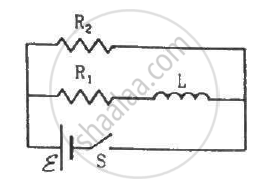
Consider the circuit shown in figure. (a) Find the current through the battery a long time after the switch S is closed. (b) Suppose the switch is again opened at t = 0. What is the time constant of the discharging circuit? (c) Find the current through the inductor after one time constant.
(i) An a.c. source of emf ε = 200 sin omegat is connected to a resistor of 50 Ω . calculate :
(1) Average current (`"I"_("avg")`)
(2) Root mean square (rms) value of emf
(ii) State any two characteristics of resonance in an LCR series circuit.
Answer the following question.
In a series LCR circuit connected across an ac source of variable frequency, obtain the expression for its impedance and draw a plot showing its variation with frequency of the ac source.
Using the phasor diagram, derive the expression for the current flowing in an ideal inductor connected to an a.c. source of voltage, v= vo sin ωt. Hence plot graphs showing the variation of (i) applied voltage and (ii) the current as a function of ωt.
Figure shows a series LCR circuit connected to a variable frequency 230 V source. L = 5.0 H, C = 80 µF, R = 40 Ω.
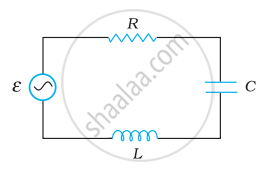
- Determine the source frequency which drives the circuit in resonance.
- Obtain the impedance of the circuit and the amplitude of current at the resonating frequency.
- Determine the rms potential drops across the three elements of the circuit. Show that the potential drop across the LC combination is zero at the resonating frequency.
A coil of 40 henry inductance is connected in series with a resistance of 8 ohm and the combination is joined to the terminals of a 2 volt battery. The time constant of the circuit is ______.
The phase diffn b/w the current and voltage at resonance is
Which of the following combinations should be selected for better tuning of an LCR circuit used for communication?
Consider the LCR circuit shown in figure. Find the net current i and the phase of i. Show that i = v/Z`. Find the impedance Z for this circuit.

A series LCR circuit containing a resistance of 120 Ω has angular resonance frequency 4 × 10⁵ rad s-1. At resonance the voltage across resistance and inductance are 60 V and 40 V respectively. At what frequency the current in the circuit lags the voltage by 45°. Give answer in ______ × 105 rad s-1.
Draw the phasor diagram for a series LRC circuit connected to an AC source.
Draw a labelled graph showing variation of impedance (Z) of a series LCR circuit Vs frequency (f) of the ac supply. Mark the resonant frequency as f0·
Which of the following combinations should be selected for better tuning of an L-C-R circuit used for communication?
Out of the following which one is NOT the characteristic of LCR series resonant circuit?
Which expression gives the sinusoidally varying voltage applied by the AC source?
What is true of the current through the resistor, inductor, and capacitor at every instant?
