Advertisements
Advertisements
प्रश्न
A series LCR circuit is connected to an ac source. Using the phasor diagram, derive the expression for the impedance of the circuit.
Advertisements
उत्तर
 LCR Circuit |
 |
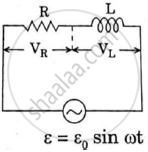
E = E0 sinωt is applied to a series LCR circuit. Since all three of them are connected in series the current through them is the same. But the voltage across each element has a different phase relation with the current.
The potential difference VL, VC and VR across L, C and R at any instant is given by VL = IXL, VC = IXC and VR = IR, where I is the current at that instant.
VR is in phase with I. VL leads I by 90° and VC lags behind I by 90° so the phasor diagram will be as shown Assuming VL > VC, the applied emf E which is equal to the resultant of the potential drop across R, L & C is given as
`E^2 = I^2[R^2 + (X_L - X_C)^2]`
Or I = `E/sqrt[[R^2 + (X_L - X_C)^2]` = `E/Z`, Where Z is Impedance.
Emf leads current by a phase angle φ as `tanφ = (V_L - V_C)/R = (X_L - X_C)/R`
APPEARS IN
संबंधित प्रश्न
Define 'quality factor' of resonance in a series LCR circuit. What is its SI unit?
Derive an expression for the average power consumed in a series LCR circuit connected to a.c. source in which the phase difference between the voltage and the current in the circuit is Φ.
An inductor-coil of inductance 17 mH is constructed from a copper wire of length 100 m and cross-sectional area 1 mm2. Calculate the time constant of the circuit if this inductor is joined across an ideal battery. The resistivity of copper = 1.7 × 10⁻⁸ Ω-m.
What will be the potential difference in the circuit when direct current is passed through the circuit?
In a series, LCR circuit, obtain an expression for the resonant frequency.
Derive an expression for the average power dissipated in a series LCR circuit.
In series combination of R, L and C with an A.C. source at resonance, if R = 20 ohm, then impedence Z of the combination is ______.
A resistance of 200Ω and an inductor of \[\frac {1}{2π}\]Н are connected in series to a.c. voltage of 40 V and 100 Hz frequency. The phase angle between the voltage and current is ______.
Which expression gives the sinusoidally varying voltage applied by the AC source?
