Advertisements
Advertisements
प्रश्न
A coil having an inductance L and a resistance R is connected to a battery of emf ε. Find the time taken for the magnetic energy stored in the circuit to change from one fourth of the steady-state value to half of the steady-state value.
Advertisements
उत्तर
Given:-
Emf of the battery = ε
Inductance of the inductor = L
Resistance = R
Maximum current in the coil `= epsilon/R`
At the steady state, current in the coil, `i =epsilon/R.`
The magnetic field energy stored at the steady state is given by
\[U = \frac{1}{2}L i^2\text{ or } U\]
\[= \frac{\epsilon^2}{2 R^2}L\]
One-fourth of the steady-state value of the magnetic energy is given by
\[U' = \frac{1}{8}L\frac{E^2}{R^2}\]
Half of the value of the steady-state energy \[=\frac{1}{4}L\frac{E^2}{R^2}\]
Let the magnetic energy reach one-fourth of its steady-state value in time t1 and let it reach half of its value in time t2.
Now,
\[\frac{1}{8}L\frac{E^2}{R^2} = \frac{1}{2}L\frac{E^2}{R^2}(1 - e^{- t_1 R/L} )^2 \]
\[ \Rightarrow 1 - e^{- t_1 R/L} = \frac{1}{2}\]
\[ \Rightarrow t_1 \frac{R}{L} = \ln 2\]
And,
\[\frac{1}{4}L\frac{E^2}{R^2} = \frac{1}{2}L\frac{E^2}{R^2}(1 - e^{- t_2 R/L} )^2 \]
\[ \Rightarrow e^{- t_2 R/L} = \frac{\sqrt{2} - 1}{\sqrt{2}} = \frac{2 - \sqrt{2}}{2}\]
\[ \Rightarrow t_1 = \tau \ln\left( \frac{1}{2 - \sqrt{2}} \right) + \ln 2\]
Thus, the time taken by the magnetic energy stored in the circuit to change from one-fourth of its steady-state value to half of its steady-state value is given by
\[t_2 - t_1 = \tau \ln\frac{1}{2 - \sqrt{2}}\]
APPEARS IN
संबंधित प्रश्न
A series LCR circuit is connected to an ac source. Using the phasor diagram, derive the expression for the impedance of the circuit. Plot a graph to show the variation of current with frequency of the source, explaining the nature of its variation.
An LR circuit having a time constant of 50 ms is connected with an ideal battery of emf ε. find the time elapsed before (a) the current reaches half its maximum value, (b) the power dissipated in heat reaches half its maximum value and (c) the magnetic field energy stored in the circuit reaches half its maximum value.
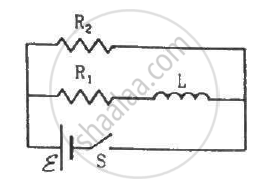
Consider the circuit shown in figure. (a) Find the current through the battery a long time after the switch S is closed. (b) Suppose the switch is again opened at t = 0. What is the time constant of the discharging circuit? (c) Find the current through the inductor after one time constant.
(i) An a.c. source of emf ε = 200 sin omegat is connected to a resistor of 50 Ω . calculate :
(1) Average current (`"I"_("avg")`)
(2) Root mean square (rms) value of emf
(ii) State any two characteristics of resonance in an LCR series circuit.
Using the phasor diagram, derive the expression for the current flowing in an ideal inductor connected to an a.c. source of voltage, v= vo sin ωt. Hence plot graphs showing the variation of (i) applied voltage and (ii) the current as a function of ωt.
For a series LCR-circuit, the power loss at resonance is ______.
In an LCR series a.c. circuit, the voltage across each of the components, L, C and R is 50V. The voltage across the LC combination will be ______.
In series LCR circuit, the phase angle between supply voltage and current is ______.
At resonance frequency the impedance in series LCR circuit is ______.
The resonant frequency of a RF oscillator is 1 MHz and its bandwidth is 10 kHz. The quality factor will be :
To reduce the resonant frequency in an LCR series circuit with a generator
A series LCR circuit containing 5.0 H inductor, 80 µF capacitor and 40 Ω resistor is connected to 230 V variable frequency ac source. The angular frequencies of the source at which power transferred to the circuit is half the power at the resonant angular frequency are likely to be ______.
Consider the LCR circuit shown in figure. Find the net current i and the phase of i. Show that i = v/Z`. Find the impedance Z for this circuit.

Draw a labelled graph showing variation of impedance (Z) of a series LCR circuit Vs frequency (f) of the ac supply. Mark the resonant frequency as f0·
The net impedance of circuit (as shown in figure) will be ______.
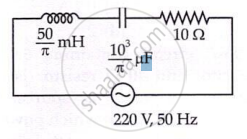
A series LCR circuit (L = 10 H, C = 10 µF, R = 50 Ω) is connected to V = 200 sin (100t). If ν0 is the resonant frequency and ν is the source frequency, then ______.
To reduce the resonant frequency in an L-C-R series circuit with a generator ______.
Out of the following which one is NOT the characteristic of LCR series resonant circuit?
Which circuit equation results from applying Kirchhoff's Voltage Law around the series LCR loop?
