Advertisements
Advertisements
प्रश्न
Use the expression for Lorentz force acting on the charge carriers of a conductor to obtain the expression for the induced emf across the conductor of length l moving with velocity v through a magnetic field B acting perpendicular to its length.
Advertisements
उत्तर
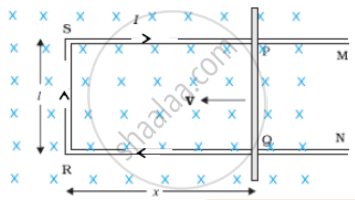
The arm PQ is moved to the left side, thus decreasing the area of the rectangular loop. This movement induces a current I as shown.
Let us consider a straight conductor moving in a uniform and time-independent magnetic field. The figure shows a rectangular conductor PQRS in which the conductor PQ is free to move. The rod PQ is moved towards the left with a constant velocity v as shown in the figure. Assume that there is no loss of energy due to friction. PQRS forms a closed circuit enclosing an area that changes as PQ moves. It is placed in a uniform magnetic field B which is perpendicular to the plane of this system. If the length RQ = x and RS l the magnetic flux ∅B enclosed by the loop PQRS will be
∅B = Blx
Since x is changing with time, the rate of change of flux φB will induce an emf given by:
`ε = -(d∅_B)/(dt) = - (d(Bl"x"))/(dt)`
= `-"B"l (d"x")/(d"t") = "B"l"v"`
where we have used dx/dt = – v which is the speed of the conductor PQ. The induced emf `"B"lv"` called motional emf. Thus, we are able to produce induced emf by moving a conductor instead of varying the magnetic field, that is, by changing the magnetic flux enclosed by the circuit. It is also possible to explain the motional emf expression by invoking the Lorentz force acting on the free charge carriers of conductor PQ. Consider any arbitrary charge q in the conductor PQ. When the rod moves with speed v, the charge will also be moving with speed v in the magnetic field B. The Lorentz force on this charge is qvB in magnitude, and its direction is towards Q. All charges experience the same force, in magnitude and direction, irrespective of their position in the rod PQ.
The work done in moving the charge from P to Q is,
`W = q"vB"l`
Since emf is the work done per unit charge,
`epsilon = "W"/q`
= `"B"l"v"`
This equation gives emf induced across the rod PQ
The total force on the charge at P is given by
`vec"F"= q(vec"E" + vec"v" xx vec"B")`
APPEARS IN
संबंधित प्रश्न
In a series LCR circuit connected to an a.c. source of voltage v = vmsinωt, use phasor diagram to derive an expression for the current in the circuit. Hence, obtain the expression for the power dissipated in the circuit. Show that power dissipated at resonance is maximum
A series LCR circuit is connected across an a.c. source of variable angular frequency 'ω'. Plot a graph showing variation of current 'i' as a function of 'ω' for two resistances R1 and R2 (R1 > R2).
Answer the following questions using this graph :
(a) In which case is the resonance sharper and why?
(b) In which case in the power dissipation more and why?
A voltage V = V0 sin ωt is applied to a series LCR circuit. Derive the expression for the average power dissipated over a cycle. Under what condition (i) no power is dissipated even though the current flows through the circuit, (ii) maximum power is dissipated in the circuit?
In a series, LCR circuit, obtain an expression for the resonant frequency.
In an L.C.R. series a.c. circuit, the current ______.
To reduce the resonant frequency in an LCR series circuit with a generator
The phase diffn b/w the current and voltage at resonance is
Draw the impedance triangle for a series LCR AC circuit and write the expressions for the impedance and the phase difference between the emf and the current.
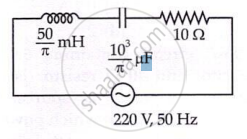
The net impedance of circuit (as shown in figure) will be ______.
To reduce the resonant frequency in an L-C-R series circuit with a generator ______.
