Advertisements
Advertisements
Question
Show, via a suitable diagram, how unpolarised light can be polarised by reflection.
Advertisements
Solution
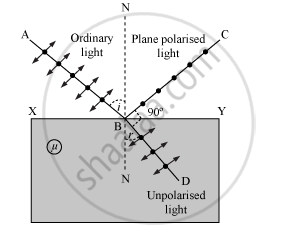
An ordinary beam of light on reflection from a transparent medium becomes partially polarised. The degree of polarisation increases as the angle of incidence is increased. At a particular value of angle of incidence, the reflected beam becomes completely polarised. This angle of incidence is called the polarising angle (p).
When light is incident at polarising angle at the interface of a refracting medium, the refractive index of the medium is equal to the tangent of the polarising angle.
μ = tan p
where
μ → Refractive index of the refracting medium
p → Polarising angle
APPEARS IN
RELATED QUESTIONS
Find an expression for intensity of transmitted light when a polaroid sheet is rotated between two crossed polaroids. In which position of the polaroid sheet will the transmitted intensity be maximum?
How does one demonstrate, using a suitable diagram, that unpolarised light when passed through a Polaroid gets polarised?
When a low flying aircraft passes overhead, we sometimes notice a slight shaking of the picture on our TV screen. Suggest a possible explanation.
Show using a proper diagram how unpolarised light can be linearly polarised by reflection from a transparent glass surface.
Light transmitted by Nicol prism is ______.
What is polarisation?
What is partially polarised light?
Which of the following phenomena is not common to sound and light waves?
An unpolarized light beam is incident on the polarizer of a polarization experiment and the intensity of light beam emerging from the analyzer is measured as 100 Lumens. Now, if the analyzer is rotated around the horizontal axis (direction of light) by 30° in clockwise direction, the intensity of emerging light will be ______ Lumens.
A polarizer - analyser set is adjusted such that the intensity of light coming out of the analyser is just 10% of the original intensity. Assuming that the polarizer - analyser set does not absorb any light, the angle by which the analyser need to be rotated further to reduce the output intensity to be zero, is ______.
