Advertisements
Advertisements
प्रश्न
Two infinitely long straight parallel wires, '1' and '2', carrying steady currents I1 and I2 in the same direction are separated by a distance d. Obtain the expression for the magnetic field `vecB`due to the wire '1' acting on wire '2'. Hence find out, with the help of a suitable diagram, the magnitude and direction of this force per unit length on wire '2' due to wire '1'. How does the nature of this force changes if the currents are in opposite direction? Use this expression to define the S.I. unit of current.
Advertisements
उत्तर
Consider a straight conductor XY lying in the plane of paper. Consider a point P at a perpendicular distance a from straight conductor.
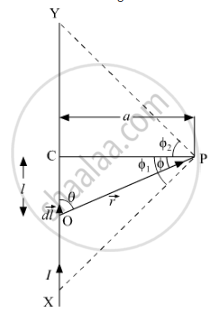
Magnetic field induction (B) at a point P due to current I passing through conductor XY is given by
`B=(μ0I)/(4πa)[sinϕ_1+sinϕ_2]`
where ϕ1 and ϕ2 are the angles made by point X and Y, respectively
At the centre of the infinite long wire, ϕ1=ϕ2=90°
`B=(μ_0I)/(4πa)[sin90^@+sin^@]`
`⇒B=μ_0/(4π) (2I)/a .....(1)`
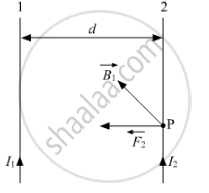
Let 1 and 2 be two long infinite straight conductors. Let I1 and I2 be the current flowing through the conductor 1 and 2 and they are d distance apart from each other as shown in the figure.
The magnetic field induction (B) at a point P on conductor 2 due to current I1 passing through conductor 1 is given by
`B=(μ_02I_1)/(4πd) ` [From (1), where a=d]
According to right hand rule, the direction of this magnetic field is perpendicular to the plane of the paper inward.
Since the conductor 2 lies in this magnetic field of conductor 1, force experienced (F2) by unit length of conductor 2 will be
F2=B1I2×1=B1I2
`∴ F2=μ_0/(4π) (2I_1I_2)/d`
Conductor 1 also experiences the same amount of force, directed towards the conductor 2. Hence, conductor 1 and conductor 2 attract each other. Thus, two linear parallel conductors carrying currents in the same direction attract and repel each other, when the current flows in the opposite direction.
Let I_1=I_1=1A; r=1 m
Then,
`F_1=F_2=F=10^(−7) (2xx1xx1)/1`
`⇒F=2×10^(−7) N/m`
Thus, one ampere is that value of constant current which when flowing through each of the two parallel uniform long linear conductors placed in free space at a distance of 1 m from each other will attract or repel each other with a force of 2 × 10⁻⁷ N per metre of their length.
APPEARS IN
संबंधित प्रश्न
Using the concept of force between two infinitely long parallel current carrying conductors, define one ampere of current.
The figure shows three infinitely long straight parallel current carrying conductors. Find the
- magnitude and direction of the net magnetic field at point A lying on conductor 1,
- magnetic force on conductor 2.

A long, straight wire carries a current along the z-axis, One can find two points in the x−y plane such that
(a) the magnetic fields are equal
(b) the directions of the magnetic fields are the same
(c) the magnitudes of the magnetic fields are equal
(d) the field at one point is opposite to that at the other point.
A long, straight wire carrying a current of 1.0 A is placed horizontally in a uniform magnetic field B = 1.0 × 10⁻⁵ T pointing vertically upward figure. Find the magnitude of the resultant magnetic field at the points P and Q, both situated at a distance of 2.0 cm from the wire in the same horizontal plane.
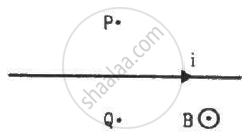
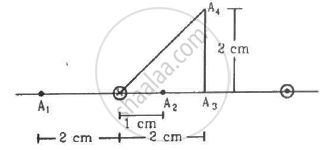
Figure shows two parallel wires separated by a distance of 4.0 cm and carrying equal currents of 10 A along opposite directions. Find the magnitude of the magnetic field B at the points A1, A2, A3.
Two parallel wires carry equal currents of 10 A along the same direction and are separated by a distance of 2.0 cm. Find the magnetic field at a point which is 2.0 cm away from each of these wires.
Two long, straight wires, each carrying a current of 5 A, are placed along the x- and y-axis respectively. The currents point along the positive directions of the axes. Find the magnetic fields at the points (a) (1 m, 1 m), (b) (−1 m, 1 m), (c) (−1 m, −1 m) and (d) (1 m, −1 m).
A straight, how wire carries a current of 20 A. Another wire carrying equal current is placed parallel to it. If the force acting on a length of 10 cm of the second wire is 2.0 × 10⁻⁵ N, what is the separation between them?
The nature of parallel and anti-parallel currents are ______.
Do magnetic forces obey Newton’s third law. Verify for two current elements dl1 = dlî located at the origin and dl2 = dlĵ located at (0, R, 0). Both carry current I.
