Advertisements
Advertisements
प्रश्न
Two infinitely long straight parallel wires, '1' and '2', carrying steady currents I1 and I2 in the same direction are separated by a distance d. Obtain the expression for the magnetic field `vecB`due to the wire '1' acting on wire '2'. Hence find out, with the help of a suitable diagram, the magnitude and direction of this force per unit length on wire '2' due to wire '1'. How does the nature of this force changes if the currents are in opposite direction? Use this expression to define the S.I. unit of current.
Advertisements
उत्तर
Consider a straight conductor XY lying in the plane of paper. Consider a point P at a perpendicular distance a from straight conductor.
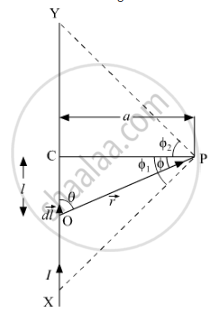
Magnetic field induction (B) at a point P due to current I passing through conductor XY is given by
`B=(μ0I)/(4πa)[sinϕ_1+sinϕ_2]`
where ϕ1 and ϕ2 are the angles made by point X and Y, respectively
At the centre of the infinite long wire, ϕ1=ϕ2=90°
`B=(μ_0I)/(4πa)[sin90^@+sin^@]`
`⇒B=μ_0/(4π) (2I)/a .....(1)`
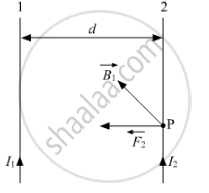
Let 1 and 2 be two long infinite straight conductors. Let I1 and I2 be the current flowing through the conductor 1 and 2 and they are d distance apart from each other as shown in the figure.
The magnetic field induction (B) at a point P on conductor 2 due to current I1 passing through conductor 1 is given by
`B=(μ_02I_1)/(4πd) ` [From (1), where a=d]
According to right hand rule, the direction of this magnetic field is perpendicular to the plane of the paper inward.
Since the conductor 2 lies in this magnetic field of conductor 1, force experienced (F2) by unit length of conductor 2 will be
F2=B1I2×1=B1I2
`∴ F2=μ_0/(4π) (2I_1I_2)/d`
Conductor 1 also experiences the same amount of force, directed towards the conductor 2. Hence, conductor 1 and conductor 2 attract each other. Thus, two linear parallel conductors carrying currents in the same direction attract and repel each other, when the current flows in the opposite direction.
Let I_1=I_1=1A; r=1 m
Then,
`F_1=F_2=F=10^(−7) (2xx1xx1)/1`
`⇒F=2×10^(−7) N/m`
Thus, one ampere is that value of constant current which when flowing through each of the two parallel uniform long linear conductors placed in free space at a distance of 1 m from each other will attract or repel each other with a force of 2 × 10⁻⁷ N per metre of their length.
APPEARS IN
संबंधित प्रश्न
Two long and parallel straight wires A and B carrying currents of 8.0 A and 5.0 A in the same direction are separated by a distance of 4.0 cm. Estimate the force on a 10 cm section of wire A.
Two long straight parallel conductors 'a' and 'b', carrying steady currents Ia and Ib are separated by a distance d. Write the magnitude and direction of the magnetic field produced by the conductor 'a' at the points along the conductor 'b'. If the currents are flowing in the same direction, what is the nature and magnitude of the force between the two conductors?
The magnetic field existing in a region is given by `vecB = B_0(1 + x/1)veck` . A square loop of edge l and carrying a current i, is placed with its edges parallel to the x−y axes. Find the magnitude of the net magnetic force experienced by the loop.
A long, straight wire carries a current i. Let B1 be the magnetic field at a point P at a distance d from the wire. Consider a section of length l of this wire such that the point P lies on a perpendicular bisector of the section B2 be the magnetic field at this point due to this second only. Find the value of d/l so that B2 differs from B1 by 1%.
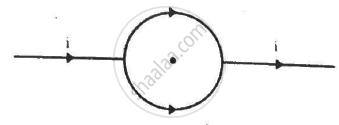
A conducting circular loop of radius a is connected to two long, straight wires. The straight wires carry a current i as shown in figure. Find the magnetic field B at the centre of the loop.
According to Ampere's circuital law, ______.
Do magnetic forces obey Newton’s third law. Verify for two current elements dl1 = dlî located at the origin and dl2 = dlĵ located at (0, R, 0). Both carry current I.
Two long parallel wires kept 2 m apart carry 3A current each, in the same direction. The force per unit length on one wire due to the other is ______.
By symmetry, the magnetic field of conductor b exerts a force on conductor a. The relationship between the two forces Fba and Fab is:
If the current Ia in conductor a is doubled while Ib and the distance d remain unchanged, the force per unit length F/L between the conductors:
