Advertisements
Advertisements
प्रश्न
Draw a necessary arrangement for winding of primary and secondary coils in a step-up transformer. State its underlying principle and derive the relation between the primary and secondary voltages in terms of number of primary and secondary turns. Mention the two basic assumptions used in obtaining the above relation.
Draw a labelled diagram of a step-up transformer. Obtain the ratio of secondary to primary voltage in terms of number of turn and currents in the two coils.
Advertisements
उत्तर
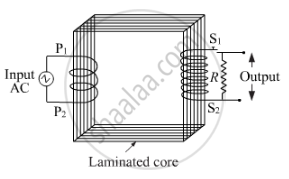
Principle: It works on the principle of mutual induction. Whenever magnetic flux linked with coil changes, an emf is induced in the neighbouring coil.
Working: When an alternating emf is supplied to the primary coil then magnetic flux linked with the secondary coil charges. As a result, an induced emf is induced in the secondary coil. Voltage at the primary and the secondary coils depends on the number of turns. Magnetic flux that is linked with the primary coil is also linked with the secondary coil. The induced emf in each turn (Eturn) of the secondary coil is equal to that of the primary coil.
Let EP be the alternating emf applied to primary coil and np be the number of turns in it. If ϕ be the electric flux associated with it, then
`E_p=−n_p (dϕ)/(dt) .....(1)`
where
(dϕ)/(dt)=Rate of change in flux across primary coil
Let Es be the emf across the secondary coil and ns be the no of turns in it. Then,
`E_s=−n_s (dϕ)/(dt) .....(2)`
Dividing (2) by (1),
`E_s/E_p=n_s/n_p=k`
For step up transformer, k > 1
∴ ES > EP
For step down transformer, k < 1
∴ ES < EP
For ideal transformer. we assume that
1. The resistance of the primary and secondary windings are negligible.
2. The energy loss due to magnetic hysterisis in the iron core is negligible.
APPEARS IN
संबंधित प्रश्न
A pair of adjacent coils has a mutual inductance of 1.5 H. If the current in one coil changes from 0 to 20 A in 0.5 s, what is the change of flux linkage with the other coil?
A pair of the adjacent coil has a mutual inductance of 1.5 H. If the current in one coil varies from 0 to 20 A in 0.5 s, what is the change of flux linked with the other coil.
An alternating current of frequency 200 rad/s and peak value 1 A is applied to the primary of a transformer. If the coefficient of mutual induction between the primary and the secondary is 1.5H, then the voltage induced in the secondary will be approximately (π = 2217)
If number of turns in primary and secondary coils is increased to two times each, the mutual inductance ______.
A rectangular coil of wire 50 turn each of area 6 x 10⁻⁴ m2 is freely suspended in a field of 3 x 10⁻² Wb / m2. Calculate the current flowing through the coil when it deflects through 60°, when torsional constant is 3.82 x 10⁻⁶ SI unit.
What is \[M_{21}\] for two coaxial solenoids with the smaller solenoid inside the larger?
Why can \[B_2\] be assumed uniform across the entire area of the inner coil?
How does wireless charging use mutual inductance?
