Advertisements
Advertisements
प्रश्न
Draw a necessary arrangement for winding of primary and secondary coils in a step-up transformer. State its underlying principle and derive the relation between the primary and secondary voltages in terms of number of primary and secondary turns. Mention the two basic assumptions used in obtaining the above relation.
Draw a labelled diagram of a step-up transformer. Obtain the ratio of secondary to primary voltage in terms of number of turn and currents in the two coils.
Advertisements
उत्तर
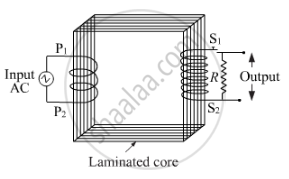
Principle: It works on the principle of mutual induction. Whenever magnetic flux linked with coil changes, an emf is induced in the neighbouring coil.
Working: When an alternating emf is supplied to the primary coil then magnetic flux linked with the secondary coil charges. As a result, an induced emf is induced in the secondary coil. Voltage at the primary and the secondary coils depends on the number of turns. Magnetic flux that is linked with the primary coil is also linked with the secondary coil. The induced emf in each turn (Eturn) of the secondary coil is equal to that of the primary coil.
Let EP be the alternating emf applied to primary coil and np be the number of turns in it. If ϕ be the electric flux associated with it, then
`E_p=−n_p (dϕ)/(dt) .....(1)`
where
(dϕ)/(dt)=Rate of change in flux across primary coil
Let Es be the emf across the secondary coil and ns be the no of turns in it. Then,
`E_s=−n_s (dϕ)/(dt) .....(2)`
Dividing (2) by (1),
`E_s/E_p=n_s/n_p=k`
For step up transformer, k > 1
∴ ES > EP
For step down transformer, k < 1
∴ ES < EP
For ideal transformer. we assume that
1. The resistance of the primary and secondary windings are negligible.
2. The energy loss due to magnetic hysterisis in the iron core is negligible.
APPEARS IN
संबंधित प्रश्न
Two circular loops are placed with their centres separated by a fixed distance. How would you orient the loops to have (a) the largest mutual inductance (b) the smallest mutual inductance?
The current in a long solenoid of radius R and having n turns per unit length is given by i= i0 sin ωt. A coil having N turns is wound around it near the centre. Find (a) the induced emf in the coil and (b) the mutual inductance between the solenoid ant the coil.
A pair of the adjacent coil has a mutual inductance of 1.5 H. If the current in one coil varies from 0 to 20 A in 0.5 s, what is the change of flux linked with the other coil.
A current I = 10 sin (50 π t) ampere is passed in the first coil which induces a maximum e.m.f. of 5 π volt in the second coil. The mutual inductance between the coils is ______.
A solenoid is connected to a battery so that a steady current flows through it. If an iron core is inserted into the solenoid, the current will ______.
Which relation defines mutual inductance using the flux linkage \[N_2\phi_{21}\] and current \[I_1\] ?
What is the effect of winding coils on a soft iron core?
What is \[M_{21}\] for two coaxial solenoids with the smaller solenoid inside the larger?
How does a transformer use mutual inductance?
