Advertisements
Advertisements
प्रश्न
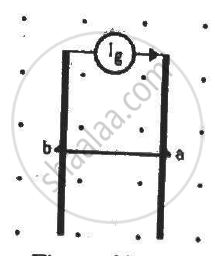
The current generator Ig' shown in figure, sends a constant current i through the circuit. The wire ab has a length l and mass m and can slide on the smooth, horizontal rails connected to Ig. The entire system lies in a vertical magnetic field B. The system is kept vertically in a uniform horizontal magnetic field B that is perpendicular to the plane of the rails (figure). It is found that the wire stays in equilibrium. If the wire ab is replaced by another wire of double its mass, how long will it take in falling through a distance equal to its length?
Advertisements
उत्तर
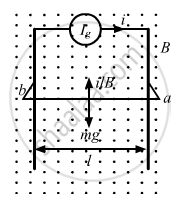
Let us consider the above free body diagram.
As the net force on the wire is zero, ilB = mg.
When the wire is replaced by a wire of double mass, we have

Now, let a' be the acceleration of the wire in downward direction and t be the time taken by the wire to fall.
Net force on the wire = 2mg − ilB = Fnet
On applying Newton's second law, we get
2mg − ilB = 2 ma' ...........(1)
\[\Rightarrow a' = \frac{2mg - ilB}{2 m}\]
\[s = ut + \frac{1}{2}a' t^2 \]
\[ \Rightarrow l = \frac{1}{2} \times \frac{2mg - ilB}{2m} \times t^2 .............\left[ \because s = l\right]\]
\[ \Rightarrow t = \sqrt{\frac{4 ml}{2mg - ilB}}\]
\[ \Rightarrow t = \sqrt{\frac{4 ml}{2mg - mg}} .........\text{[From (1)]}\]
` t = 2sqrt(l/g)`
APPEARS IN
संबंधित प्रश्न
Two identical coils P and Q each of radius R are lying in perpendicular planes such that they have a common centre. Find the magnitude and direction of the magnetic field at the common centre of the two coils, if they carry currents equal to I and \[\sqrt{3}\] I respectively.

The motion of copper plate is damped when it is allowed to oscillate between the two poles of a magnet. What is the cause of this damping?
Two proton beams going in the same direction repel each other whereas two wires carrying currents in the same direction attract each other. Explain.
Consider a long, straight wire of cross-sectional area A carrying a current i. Let there be n free electrons per unit volume. An observer places himself on a trolley moving in the direction opposite to the current with a speed \[v = \frac{i}{\text{nAe}}\] and separation from the wire by a distance r. The magnetic field seen by the observer is very nearly
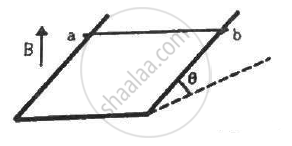
A wire ab of length l, mass m and resistance R slides on a smooth, thick pair of metallic rails joined at the bottom as shown in figure. The plane of the rails makes an angle θ with the horizontal. A vertical magnetic field B exists in the region. If the wire slides on the rails at a constant speed v, show that \[B = \sqrt{\frac{mg R sin\theta}{v l^2 \cos^2 \theta}}\]
A charged particle moves through a magnetic field perpendicular to its direction. Then ______.
If an electron is moving with velocity `vecnu` produces a magnetic field `vec"B"`, then ______.
A moving charge will gain kinetic energy due to the application of ______.
A circular coil of radius 10 cm is placed in a uniform magnetic field of 3.0 × 10⁻⁵ T with its plane perpendicular to the field initially. It is rotated at constant angular speed about an axis along the diameter of coil and perpendicular to magnetic field so that it undergoes half of rotation in 0.2 s. The maximum value of EMF induced (in µV) in the coil will be close to the integer ______.
A charged particle is accelerated through a potential difference of 12 kV and acquires a speed of 106 ms-1. It is projected perpendicularly into the magnetic field of strength 0.2 T. The radius of the circle described is ______ cm.
Protons and singly ionized atoms of U235 and U238 are passed in turn (which means one after the other and not at the same time) through a velocity selector and then enter a uniform magnetic field. The protons describe semicircles of radius 10 mm. The separation between the ions of U235 and U238 after describing the semicircle is given by ______.
An electron (mass 9 × 10⁻³¹ kg and charge 1.6 × 10⁻¹⁹ C) moving with speed c/100 (c = speed of light)is injected into a magnetic field `vecB` of magnitude 9 × 10⁻⁴ T perpendicular to its direction of motion. We wish to apply an uniform electric field `vecE` together with the magnetic field so that the electron does not deflect from its path. Then (speed of light c = 3 × 10⁸ m s−1).
A particle of mass m and charge q moves with speed v perpendicular to a magnetic field B. Equating the magnetic force to the centripetal force, the radius of the circular path is:
Which property of the cyclotron motion of a charged particle in a magnetic field forms the basis of particle accelerators?
A charged particle's velocity makes an angle θ with a magnetic field \[\vec B\], where 0° < θ < 90°. The perpendicular component of velocity \[v_\perp = v \sin\theta\] is responsible for:
The pitch of the helix described by a charged particle in a magnetic field is given by:
An electron (mass \[9 \times 10^{-31}\] kg, charge \[1.6 \times 10^{-19}\] C) moves at \[3 \times 10^7\] m/s in a magnetic field of \[6 \times 10^{-4}\] T perpendicular to its velocity. The radius of its circular path is:
An electron moves at \[3 \times 10^7\] m/s in a circular path of radius 0.28 m in a magnetic field. Its frequency of revolution is approximately:
