Advertisements
Advertisements
प्रश्न
Two proton beams going in the same direction repel each other whereas two wires carrying currents in the same direction attract each other. Explain.
Advertisements
उत्तर
Two proton beams going in the same direction repel each other, as they are like charges and we know that like charges repel each other.
When a charge is in motion then a magnetic field is associated with it. Two wires carrying currents in the same direction produce their fields (acting on each other) in opposite directions so the resulting magnetic force acting on them is attractive. Due to the magnetic force, these two wires attract each other.
But when a charge is at rest then only an electric field is associated with it and no magnetic fiels is produced by it. So at rest, it repels a like charge by exerting a electric force on it.
Charge in motion can produce both electric field and magnetic field.
The attractive force between two current carrying wires is due to the magnetic field and repulsive force is due to the electric field.
APPEARS IN
संबंधित प्रश्न
Depict the behaviour of magnetic field lines in the presence of a diamagnetic material?
If an electric field \[\vec{E}\] is also applied such that the particle continues moving along the original straight line path, what should be the magnitude and direction of the electric field \[\vec{E}\] ?
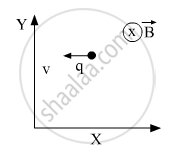
Show with the help of a diagram how the force between the two conductors would change when the currents in them flow in the opposite directions?
The motion of copper plate is damped when it is allowed to oscillate between the two poles of a magnet. What is the cause of this damping?
Two long straight parallel conductors carrying steady currents I1 and I2 are separated by a distance 'd'. Explain briefly, with the help of a suitable diagram, how the magnetic field due to one conductor acts on the other. Hence deduce the expression for the force acting between the two conductors. Mention the nature of this force.
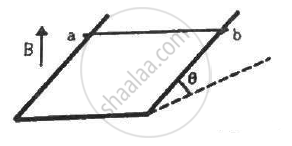
A wire ab of length l, mass m and resistance R slides on a smooth, thick pair of metallic rails joined at the bottom as shown in figure. The plane of the rails makes an angle θ with the horizontal. A vertical magnetic field B exists in the region. If the wire slides on the rails at a constant speed v, show that \[B = \sqrt{\frac{mg R sin\theta}{v l^2 \cos^2 \theta}}\]
A magnetic field that varies in magnitude from point to point but has a constant direction (east to west) is set up in a chamber. A charged particle enters the chamber and travels undeflected along a straight path with constant speed. What can you say about the initial velocity of the particle?
A charged particle moves through a magnetic field perpendicular to its direction. Then ______.
-
The presence of a large magnetic flux through a coil maintains a current in the coil if the circuit is continuous.
-
A coil of a metal wire kept stationary in a non– uniform magnetic field has an e.m.f induced in it.
-
A charged particle enters a region of uniform magnetic field at an angle of 85° to the magnetic lines of force, the path of the particle is a circle.
-
There is no change in the energy of a charged particle moving in a magnetic field although a magnetic force is acting on it.
If an electron is moving with velocity `vecnu` produces a magnetic field `vec"B"`, then ______.
A charged particle moving in a magnetic field experiences a resultant force ______
A beam of protons with speed 4 × 10⁵ ms-1 enters a uniform magnetic field of 0.3 T at an angle of 60° to the magnetic field. The pitch of the resulting helical path of protons is close to :
(Mass of the proton = 1.67 × 10⁻²⁷ kg, charge of the proton = 1.69 × 10⁻¹⁹ C)
The work done by the magnetic force on a moving charged particle is:
Which of the following statements about the magnetic force and electric force is TRUE regarding energy transfer to a charged particle?
A particle of mass m and charge q moves with speed v perpendicular to a magnetic field B. Equating the magnetic force to the centripetal force, the radius of the circular path is:
The angular frequency of revolution of a charged particle in a magnetic field is given by:
The time period of revolution of a charged particle in a uniform magnetic field is:
