Advertisements
Advertisements
Question
A point charge Q is placed at point 'O' as shown in the figure. Is the potential at point A, i.e. VA, greater, smaller or equal to potential, VB, at point B, when Q is (i) positive, and (ii) negative charge?
Advertisements
Solution
A positive charge creates a positive potential around it in space while a negative charge creates a negative potential around it.
As we move away from the charge radially, the potential decreases. For positive charge the positive potential decreases and for negative charge negative potential decreases.
(i) If the charge is positive then the potential at point A is more positive than the potential at point B. For example, it can be 6 V at A and 3 V at B. So, if you find the potential difference, it will be 3 V.
VA > VB
(ii) If the charge is negative then the potential at point A is more negative than the potential at point B. For example, it can be -6 V at A and -3 V at B. So, if you find the potential difference, it will be [-6-(-3)]=-3 V
VA < VB
APPEARS IN
RELATED QUESTIONS
Four point charges Q, q, Q and q are placed at the corners of a square of side 'a' as shown in the figure.
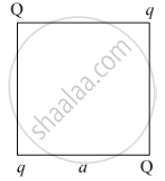
Find the
1) resultant electric force on a charge Q, and
2) potential energy of this system.
A point charge Q is placed at point O as shown in the figure. The potential difference VA – VB positive. Is the charge Q negative or positive?
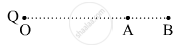
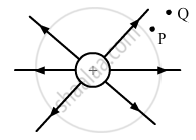
Figure shows the field lines due to a positive point charge. Give the sign of potential energy difference of a small negative charge between the points Q and P.
Calculate potential energy of a point charge – q placed along the axis due to a charge +Q uniformly distributed along a ring of radius R. Sketch P.E. as a function of axial distance z from the centre of the ring. Looking at graph, can you see what would happen if – q is displaced slightly from the centre of the ring (along the axis)?
- Assertion (A): Work done in moving a charge around a closed path, in an electric field is always zero.
- Reason (R): Electrostatic force is a conservative force.
The symbol, SI unit, and nature of electrostatic potential energy are respectively:
If a system of like charges, assembled by doing work against their repulsive force, is released, the stored electrostatic potential energy:
For a system of unlike charges (attractive force), an external agent must do work to separate them because the system:
The total electrostatic potential energy of a three-charge system is:
For n charges \[q_1, q_2, \ldots, q_n\] at positions \[r_1, r_2, \ldots, r_n\], where \[r_{ij}\] is the distance between charge i and charge j, the total electrostatic potential energy of the system is:
