Advertisements
Advertisements
Question
In a double slit interference experiment, the separation between the slits is 1.0 mm, the wavelength of light used is 5.0 × 10⁻⁷ m and the distance of the screen from the slits is 1.0m. (a) Find the distance of the centre of the first minimum from the centre of the central maximum. (b) How many bright fringes are formed in one centimetre width on the screen?
Advertisements
Solution
Given
Separation between the two slits,
\[d = 1 mm = {10}^{- 3} m\]
Wavelength of the light used,
\[\lambda = 5 . 0 \times {10}^{- 7} m\]
Distance between screen and slit,
\[D = 1 m\]
(a) The distance of the centre of the first minimum from the centre of the central maximum, \[x = \frac{\text{width of central maxima}}{2}\]
That is,
\[x = \frac{\beta}{2} = \frac{\lambda D}{2d}...........(1)\]
\[= \frac{5 \times {10}^{- 7} \times 1}{2 \times {10}^{- 3}}\]
\[ = 2 . 5 \times {10}^{- 4} m = 0 . 25 mm\]
(b) From equation (1),
fringe width,
\[\beta = 2 \times x = 0 . 50 mm\]
So, number of bright fringes formed in one centimetre (10 mm) = \[\frac{10}{0 . 50} = 20\]
APPEARS IN
RELATED QUESTIONS
The ratio of the intensities at minima to the maxima in the Young's double slit experiment is 9 : 25. Find the ratio of the widths of the two slits.
A beam of light consisting of two wavelengths, 650 nm and 520 nm, is used to obtain interference fringes in a Young’s double-slit experiment.
Find the distance of the third bright fringe on the screen from the central maximum for wavelength 650 nm.
In a double-slit experiment the angular width of a fringe is found to be 0.2° on a screen placed 1 m away. The wavelength of light used is 600 nm. What will be the angular width of the fringe if the entire experimental apparatus is immersed in water? Take refractive index of water to be 4/3.
Using analytical method for interference bands, obtain an expression for path difference between two light waves.
The fringes produced in diffraction pattern are of _______.
(A) equal width with same intensity
(B) unequal width with varying intensity
(C) equal intensity\
(D) equal width with varying intensity
In Young's double slit experiment, derive the condition for
(i) constructive interference and
(ii) destructive interference at a point on the screen.
How does the fringe width get affected, if the entire experimental apparatus of Young is immersed in water?
If Young's double slit experiment is performed in water, _________________ .
A double slit S1 − S2 is illuminated by a coherent light of wavelength \[\lambda.\] The slits are separated by a distance d. A plane mirror is placed in front of the double slit at a distance D1 from it and a screen ∑ is placed behind the double slit at a distance D2 from it (see the following figure). The screen ∑ receives only the light reflected by the mirror. Find the fringe-width of the interference pattern on the screen.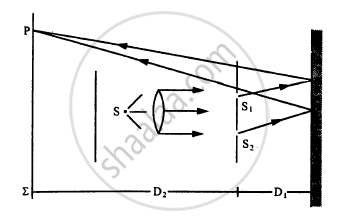
In a Young's double slit experiment, \[\lambda = 500\text{ nm, d = 1.0 mm and D = 1.0 m.}\] Find the minimum distance from the central maximum for which the intensity is half of the maximum intensity.
Wavefront is ______.
In a Young’s double slit experiment, the source is white light. One of the holes is covered by a red filter and another by a blue filter. In this case ______.
How will the interference pattern in Young's double-slit experiment be affected if the source slit is moved away from the plane of the slits?
In a Young's double slit experiment, the width of the one of the slit is three times the other slit. The amplitude of the light coming from a slit is proportional to the slit- width. Find the ratio of the maximum to the minimum intensity in the interference pattern.
- Assertion (A): In Young's double slit experiment all fringes are of equal width.
- Reason (R): The fringe width depends upon the wavelength of light (λ) used, the distance of the screen from the plane of slits (D) and slits separation (d).
Why does the phase difference between light from ordinary sources change randomly?
What is required to obtain a clear interference pattern?
What does \(\lambda\) denote in the fringe-position expressions?
