Advertisements
Advertisements
Question
In Young’s double slit experiment, how is interference pattern affected when the following changes are made:
- Slits are brought closer to each other.
- Screen is moved away from the slits.
- Red coloured light is replaced with blue coloured light.
Advertisements
Solution
- Fringe width (separation) increases.
- Fringe width (separation) increases.
- Fringe width (separation) decreases.
APPEARS IN
RELATED QUESTIONS
Show that the fringe pattern on the screen is actually a superposition of slit diffraction from each slit.
If Young's double slit experiment is performed in water, _________________ .
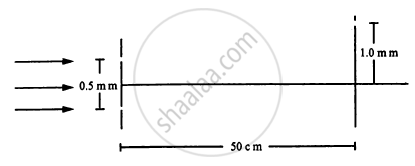
White coherent light (400 nm-700 nm) is sent through the slits of a Young's double slit experiment (see the following figure). The separation between the slits is 0⋅5 mm and the screen is 50 cm away from the slits. There is a hole in the screen at a point 1⋅0 mm away (along the width of the fringes) from the central line. (a) Which wavelength(s) will be absent in the light coming from the hole? (b) Which wavelength(s) will have a strong intensity?
In a Young's double slit experiment, \[\lambda = 500\text{ nm, d = 1.0 mm and D = 1.0 m.}\] Find the minimum distance from the central maximum for which the intensity is half of the maximum intensity.
Draw the intensity distribution as function of phase angle when diffraction of light takes place through coherently illuminated single slit.
The Young's double slit experiment is performed with blue and with green light of wavelengths 4360Å and 5460Å respectively. If x is the distance of 4th maxima from the central one, then:
A slit of width 0.6 mm is illuminated by a beam of light consisting of two wavelengths 600 nm and 480 nm. The diffraction pattern is observed on a screen 1.0 m from the slit. Find:
- The distance of the second bright fringe from the central maximum pertaining to the light of 600 nm.
- The least distance from the central maximum at which bright fringes due to both wavelengths coincide.
In a double-slit experiment with monochromatic light, fringes are obtained on a screen placed at some distance from the plane of slits. If the screen is moved by 5 × 10⁻² m towards the slits, the change in fringe width is 3 × 10⁻³ cm. If the distance between the slits is 1 mm, then the wavelength of the light will be ______ nm.
What is the consequence of random phase variation for ordinary light sources?
What does \(x\) denote when deriving fringe positions?
