Advertisements
Advertisements
Question
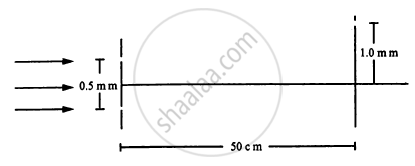
White coherent light (400 nm-700 nm) is sent through the slits of a Young's double slit experiment (see the following figure). The separation between the slits is 0⋅5 mm and the screen is 50 cm away from the slits. There is a hole in the screen at a point 1⋅0 mm away (along the width of the fringes) from the central line. (a) Which wavelength(s) will be absent in the light coming from the hole? (b) Which wavelength(s) will have a strong intensity?
Advertisements
Solution
Given:-
Separation between two slits,
\[d = 0 . 5 mm = 0 . 5 \times {10}^{- 3} m\]
Wavelength of the light,
\[\lambda = 400\text{ nm to 700 nm}\]
Distance of the screen from the slit,
\[D = 50 cm = 0 . 5 m\]
Position of hole on the screen,
\[y_n = 1 mm = 1 \times {10}^{- 3} m\]
(a) The wavelength(s) will be absent in the light coming from the hole, which will form a dark fringe at the position of hole.
\[y_n = \frac{\left( 2n + 1 \right) \lambda_n}{2}\frac{D}{d}\text{, where n = 0, 1, 2, ......}\]
\[\Rightarrow \lambda_n = \frac{2}{\left( 2n + 1 \right)} \frac{y_n d}{D}\]
\[= \frac{2}{\left( 2n + 1 \right)} \times \frac{{10}^{- 3} \times 0 . 05 \times {10}^{- 3}}{0 . 5}\]
\[= \frac{2}{\left( 2n + 1 \right)} \times {10}^{- 6} m\]
\[= \frac{2}{\left( 2n + 1 \right)} \times {10}^3 nm\]
For n = 1,
\[ \lambda_1 = \left( \frac{2}{3} \right) \times 1000 = 667 nm\]
For n = 2,
\[ \lambda_2 = \left( \frac{2}{5} \right) \times 1000 = 400 nm\]
Thus, the light waves of wavelength 400 nm and 667 nm will be absent from the light coming from the hole.
(b) The wavelength(s) will have a strong intensity, which will form a bright fringe at the position of the hole.
So, \[y_n = n \lambda_n \frac{D}{d}\]
\[ \Rightarrow \lambda_n = y_n \frac{d}{nD}\]
For n = 1,
\[ \lambda_1 = y_n \frac{d}{D}\]
\[ = {10}^{- 3} \times \left( 0 . 5 \right) \times \frac{{10}^{- 3}}{0 . 5}\]
\[ = {10}^{- 6} m = 1000 nm.\]
But 1000 nm does not fall in the range 400 nm to 700 nm.
Again, for n = 2,
\[ \lambda_2 = y_n \frac{d}{2D} = 500 nm\]
So, the light of wavelength 500 nm will have strong intensity.
APPEARS IN
RELATED QUESTIONS
Using monochromatic light of wavelength λ in Young’s double slit experiment, the eleventh dark fringe is obtained on the screen for a phase difference of ______.
A beam of light consisting of two wavelengths, 650 nm and 520 nm, is used to obtain interference fringes in a Young’s double-slit experiment.
Find the distance of the third bright fringe on the screen from the central maximum for wavelength 650 nm.
In Young’s experiment, the ratio of intensity at the maxima and minima in an interference
pattern is 36 : 9. What will be the ratio of the intensities of two interfering waves?
Explain two features to distinguish between the interference pattern in Young's double slit experiment with the diffraction pattern obtained due to a single slit.
In Young’s double slit experiment, show graphically how the intensity of light varies with distance
Write two characteristics features distinguish the diffractions pattern from the interference fringes obtained in Young’s double slit experiment.
Can we perform Young's double slit experiment with sound waves? To get a reasonable "fringe pattern", what should be the order of separation between the slits? How can the bright fringes and the dark fringes be detected in this case?
If the separation between the slits in a Young's double slit experiment is increased, what happens to the fringe-width? If the separation is increased too much, will the fringe pattern remain detectable?
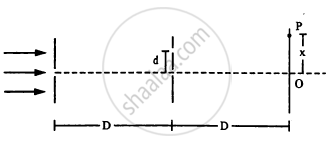
Consider the arrangement shown in the figure. The distance D is large compared to the separation d between the slits.
- Find the minimum value of d so that there is a dark fringe at O.
- Suppose d has this value. Find the distance x at which the next bright fringe is formed.
- Find the fringe-width.
In Young's double slit experiment using monochromatic light of wavelength 600 nm, 5th bright fringe is at a distance of 0·48 mm from the centre of the pattern. If the screen is at a distance of 80 cm from the plane of the two slits, calculate:
(i) Distance between the two slits.
(ii) Fringe width, i.e. fringe separation.
In Young’s double-slit experiment, using monochromatic light, fringes are obtained on a screen placed at some distance from the slits. If the screen is moved by 5 x 10⁻² m towards the slits, the change in the fringe width is 3 x 10⁻⁵ m. If the distance between the two slits is 10-3 m, calculate the wavelength of the light used.
"If the slits in Young's double slit experiment are identical, then intensity at any point on the screen may vary between zero and four times to the intensity due to single slit".
Justify the above statement through a relevant mathematical expression.
A projectile can have the same range R for two angles of projection. If t1 and t2 be the times of flight in two cases, then what is the product of two times of flight?
Consider a two-slit interference arrangement (Figure) such that the distance of the screen from the slits is half the distance between the slits. Obtain the value of D in terms of λ such that the first minima on the screen falls at a distance D from the centre O.

Using Young’s double slit experiment, a monochromatic light of wavelength 5000Å produces fringes of fringe width 0.5 mm. If another monochromatic light of wavelength 6000Å is used and the separation between the slits is doubled, then the new fringe width will be ______.
In a double-slit experiment with monochromatic light, fringes are obtained on a screen placed at some distance from the plane of slits. If the screen is moved by 5 × 10⁻² m towards the slits, the change in fringe width is 3 × 10⁻³ cm. If the distance between the slits is 1 mm, then the wavelength of the light will be ______ nm.
A fringe width of 6 mm was produced for two slits separated by 1 mm apart. The screen is placed 10 m away. The wavelength of light used is 'x' nm. The value of 'x' to the nearest integer is ______.
Interference fringes are observed on a screen by illuminating two thin slits 1 mm apart with a light source (λ = 632.8 nm). The distance between the screen and the slits is 100 cm. If a bright fringe is observed on a screen at distance of 1.27 mm from the central bright fringe, then the path difference between the waves, which are reaching this point from the slits is close to :
