Advertisements
Advertisements
प्रश्न
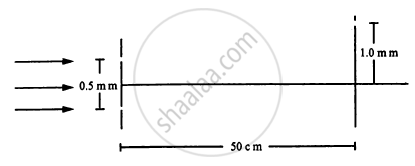
White coherent light (400 nm-700 nm) is sent through the slits of a Young's double slit experiment (see the following figure). The separation between the slits is 0⋅5 mm and the screen is 50 cm away from the slits. There is a hole in the screen at a point 1⋅0 mm away (along the width of the fringes) from the central line. (a) Which wavelength(s) will be absent in the light coming from the hole? (b) Which wavelength(s) will have a strong intensity?
Advertisements
उत्तर
Given:-
Separation between two slits,
\[d = 0 . 5 mm = 0 . 5 \times {10}^{- 3} m\]
Wavelength of the light,
\[\lambda = 400\text{ nm to 700 nm}\]
Distance of the screen from the slit,
\[D = 50 cm = 0 . 5 m\]
Position of hole on the screen,
\[y_n = 1 mm = 1 \times {10}^{- 3} m\]
(a) The wavelength(s) will be absent in the light coming from the hole, which will form a dark fringe at the position of hole.
\[y_n = \frac{\left( 2n + 1 \right) \lambda_n}{2}\frac{D}{d}\text{, where n = 0, 1, 2, ......}\]
\[\Rightarrow \lambda_n = \frac{2}{\left( 2n + 1 \right)} \frac{y_n d}{D}\]
\[= \frac{2}{\left( 2n + 1 \right)} \times \frac{{10}^{- 3} \times 0 . 05 \times {10}^{- 3}}{0 . 5}\]
\[= \frac{2}{\left( 2n + 1 \right)} \times {10}^{- 6} m\]
\[= \frac{2}{\left( 2n + 1 \right)} \times {10}^3 nm\]
For n = 1,
\[ \lambda_1 = \left( \frac{2}{3} \right) \times 1000 = 667 nm\]
For n = 2,
\[ \lambda_2 = \left( \frac{2}{5} \right) \times 1000 = 400 nm\]
Thus, the light waves of wavelength 400 nm and 667 nm will be absent from the light coming from the hole.
(b) The wavelength(s) will have a strong intensity, which will form a bright fringe at the position of the hole.
So, \[y_n = n \lambda_n \frac{D}{d}\]
\[ \Rightarrow \lambda_n = y_n \frac{d}{nD}\]
For n = 1,
\[ \lambda_1 = y_n \frac{d}{D}\]
\[ = {10}^{- 3} \times \left( 0 . 5 \right) \times \frac{{10}^{- 3}}{0 . 5}\]
\[ = {10}^{- 6} m = 1000 nm.\]
But 1000 nm does not fall in the range 400 nm to 700 nm.
Again, for n = 2,
\[ \lambda_2 = y_n \frac{d}{2D} = 500 nm\]
So, the light of wavelength 500 nm will have strong intensity.
APPEARS IN
संबंधित प्रश्न
What is the effect on the fringe width if the distance between the slits is reduced keeping other parameters same?
In Young’s double slit experiment, show graphically how the intensity of light varies with distance
Find the intensity at a point on a screen in Young's double slit experiment where the interfering waves have a path difference of (i) λ/6, and (ii) λ/2.
In Young's double slit experiment, derive the condition for
(i) constructive interference and
(ii) destructive interference at a point on the screen.
If the separation between the slits in a Young's double slit experiment is increased, what happens to the fringe-width? If the separation is increased too much, will the fringe pattern remain detectable?
A Young's double slit experiment is performed with white light.
(a) The central fringe will be white.
(b) There will not be a completely dark fringe.
(c) The fringe next to the central will be red.
(d) The fringe next to the central will be violet.
White light is used in a Young's double slit experiment. Find the minimum order of the violet fringe \[\left( \lambda = 400\text{ nm} \right)\] which overlaps with a red fringe \[\left( \lambda = 700\text{ nm} \right).\]
In a Young's double slit interference experiment, the fringe pattern is observed on a screen placed at a distance D from the slits. The slits are separated by a distance d and are illuminated by monochromatic light of wavelength \[\lambda.\] Find the distance from the central point where the intensity falls to (a) half the maximum, (b) one-fourth the maximum.
In Young's double slit experiment using monochromatic light of wavelength 600 nm, 5th bright fringe is at a distance of 0·48 mm from the centre of the pattern. If the screen is at a distance of 80 cm from the plane of the two slits, calculate:
(i) Distance between the two slits.
(ii) Fringe width, i.e. fringe separation.
Wavefront is ______.
When a beam of light is used to determine the position of an object, the maximum accuracy is achieved, if the light is ______.
In Young’s double slit experiment, what should be the phase difference between the two overlapping waves to obtain 5th dark band/fringe on the screen?
In Young's double slit experiment, the minimum amplitude is obtained when the phase difference of super-imposing waves is: (where n = 1, 2, 3, ...)
ASSERTION (A): In an interference pattern observed in Young's double slit experiment, if the separation (d) between coherent sources as well as the distance (D) of the screen from the coherent sources both are reduced to 1/3rd, then new fringe width remains the same.
REASON (R): Fringe width is proportional to (d/D).
How will the interference pattern in Young's double-slit experiment be affected if the source slit is moved away from the plane of the slits?
In Young's double-slit experiment, the separation between the two slits is d and the distance of the screen from the slits is 1000 d. If the first minima fall at a distance d from the central maximum, obtain the relation between d and λ.
In Young's double slit experiment, the distance of the 4th bright fringe from the centre of the interference pattern is 1.5 mm. The distance between the slits and the screen is 1.5 m, and the wavelength of light used is 500 nm. Calculate the distance between the two slits.
In Young's double slit experiment, show that:
`β = (λ"D")/"d"`
Where the terms have their usual meaning.
What is fringe width?
