Advertisements
Advertisements
Question
Using analytical method for interference bands, obtain an expression for path difference between two light waves.
Advertisements
Solution
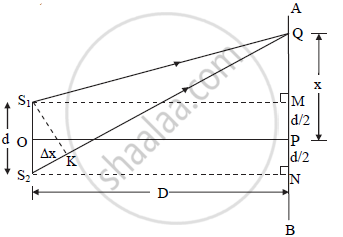
a) Let S1 and S2 be the two coherent monochromatic sources which are separated by short distance d. They emit light waves of wavelength λ
b) Let D = horizontal distance between screen and source
c) Draw S1M and S2N ⊥ AB
OP = perpendicular bisector of slit.
Since S1P = S2P, the path difference between waves reaching P from S1 and S2 is zero, therefore there is a bright point at P.
d) Consider a point Q on the screen which is at a distance x from the central point P on the screen. Light waves from S1 and S2 reach at Q simultaneously by covering path S1Q and S2Q, where they superimpose
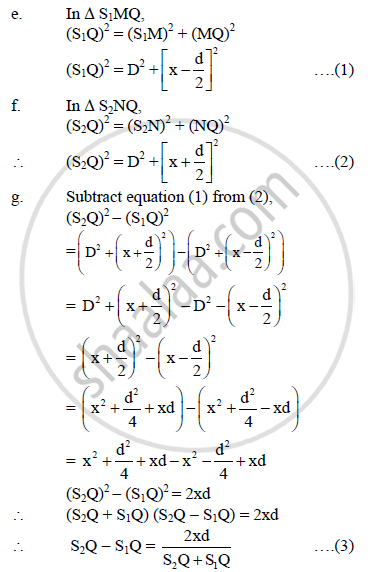
h). If x << D and d << D then,
S1Q ≈ S2Q ≈ D
S2Q + S1Q = 2D
∴ Equation (3) becomes,
`S_2Q - S_1Q = (2xd)/(2D)`
`:. S_2Q - S_1Q = (xd)/D`
`:.trianglex = (xd)/D` .........4
Equation (4) gives the path difference of two interfering light waves
APPEARS IN
RELATED QUESTIONS
Derive an expression for path difference in Young’s double slit experiment and obtain the conditions for constructive and destructive interference at a point on the screen.
Show that the angular width of the first diffraction fringe is half that of the central fringe.
In Young's double slit experiment, describe briefly how bright and dark fringes are obtained on the screen kept in front of a double slit. Hence obtain the expression for the fringe width.
Using monochromatic light of wavelength λ in Young’s double slit experiment, the eleventh dark fringe is obtained on the screen for a phase difference of ______.
A beam of light consisting of two wavelengths, 650 nm and 520 nm, is used to obtain interference fringes in a Young’s double-slit experiment.
Find the distance of the third bright fringe on the screen from the central maximum for wavelength 650 nm.
Suppose white light falls on a double slit but one slit is covered by a violet filter (allowing λ = 400 nm). Describe the nature of the fringe pattern observed.
The slits in a Young's double slit experiment have equal width and the source is placed symmetrically with respect to the slits. The intensity at the central fringe is I0. If one of the slits is closed, the intensity at this point will be ____________ .
A thin transparent sheet is placed in front of a Young's double slit. The fringe-width will _____________ .
Find the angular separation between the consecutive bright fringes in a Young's double slit experiment with blue-green light of wavelength 500 nm. The separation between the slits is \[2 \cdot 0 \times {10}^{- 3}m.\]
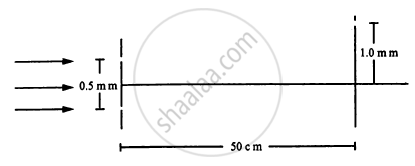
White coherent light (400 nm-700 nm) is sent through the slits of a Young's double slit experiment (see the following figure). The separation between the slits is 0⋅5 mm and the screen is 50 cm away from the slits. There is a hole in the screen at a point 1⋅0 mm away (along the width of the fringes) from the central line. (a) Which wavelength(s) will be absent in the light coming from the hole? (b) Which wavelength(s) will have a strong intensity?
In a Young's double slit experiment, the separation between the slits = 2.0 mm, the wavelength of the light = 600 nm and the distance of the screen from the slits = 2.0 m. If the intensity at the centre of the central maximum is 0.20 W m−2, what will be the intensity at a point 0.5 cm away from this centre along the width of the fringes?
In Young's double-slit experiment, the two slits are separated by a distance of 1.5 mm, and the screen is placed 1 m away from the plane of the slits. A beam of light consisting of two wavelengths of 650 nm and 520 nm is used to obtain interference fringes.
Find the distance of the third bright fringe for λ = 520 nm on the screen from the central maximum.
The force required to double the length of a steel wire of area 1 cm2, if its Young's modulus Y= 2 × 10¹¹/m2 is:
Two balls are projected at an angle θ and (90° − θ) to the horizontal with the same speed. The ratio of their maximum vertical heights is:
Two slits, 4mm apart, are illuminated by light of wavelength 6000 A° what will be the fringe width on a screen placed 2 m from the slits?
How will the interference pattern in Young's double-slit experiment be affected if the source slit is moved away from the plane of the slits?
In Young's double slit experiment, the distance of the 4th bright fringe from the centre of the interference pattern is 1.5 mm. The distance between the slits and the screen is 1.5 m, and the wavelength of light used is 500 nm. Calculate the distance between the two slits.
If the monochromatic source in Young’s double slit experiment is replaced by white light, then ______.
What is a fringe?
What is fringe width?
Why do the two narrow slits in Young's experiment act as coherent sources?
What is the interference pattern observed on the screen in Young's double-slit experiment?
What is the fringe width \(\beta\) in Young's double-slit experiment?
What is the angular fringe width \(\alpha\)?
What happens to fringe width when the screen distance increases while wavelength and slit separation remain unchanged?
What happens to fringe width when slit separation increases while wavelength and screen distance remain unchanged?
