Advertisements
Advertisements
Question
(i) In Young's double-slit experiment, deduce the condition for (a) constructive and (b) destructive interferences at a point on the screen. Draw a graph showing variation of intensity in the interference pattern against position 'x' on the screen.
(b) Compare the interference pattern observed in Young's double-slit experiment with single-slit diffraction pattern, pointing out three distinguishing features.
Advertisements
Solution
Expression for Fringe Width in Young’s Double-Slit Experiment
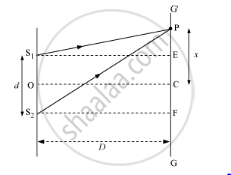
Let S1 and S2 be two slits separated by a distance d. `GG'` is the screen at a distance D from the slits S1and S2. Point C is equidistant from both the slits. The intensity of light will be maximum at this point because the path difference of the waves reaching this point will be zero.
At point P, the path difference between the rays coming from the slits is given by
S1= S2P − S1P
Now, S1 S2 = d, EF = d, and S2F = D
In ΔS2PF,
`S_2P=[S_2F^2+PF^2]^(1/2)`
`S_2P=[D2+(x+d/2)^2]^(1/2)`
`=D[1+(x+d/2)^2/D^2]^(1/2)`
Similarly, in ΔS1PE
`S_1P=D[1+(x-d/2)^2/D^2]^(1/2)`
`:.S_2P-S_1P=D[1+1/2(x+d/2)^2/D^2)]-D[1+1/2(x-d/2)^2/D^2]`
On expanding it binomially, we get
`S_2P-S_1P=1/(2D)[4xd/2]=(xd)/D`
For constructive interference, the path difference is an integral multiple of wavelengths, that is, path difference is nλ.
`:.nlambda=(xd)/D`
`x=(nlambdaD)/d`
where n = 0, 1, 2, 3, 4, …
Similarly, for destructive interference,
`x_n=(2n-1)lambda/2D/d`
Graph of Intensity Distribution in Young’s Double-Slit Experiment
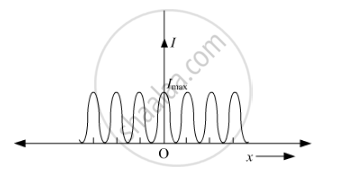
(ii) On comparing the interference pattern observed in Young's double slit experiment (interference) with single-slit diffraction pattern (diffraction), we can have three distinguishing features:
In the interference pattern, all the bright fringes have the same intensity. In a diffraction pattern, all the bright fringes are not of the same intensity
In the interference pattern, the dark fringe has zero or very small intensity so that the bright and dark fringes can easily be distinguished. In diffraction pattern, all the dark fringes are not of zero intensity
In the interference pattern, the widths of all the fringes are almost the same, whereas in diffraction pattern, the fringes are of different widths
RELATED QUESTIONS
In Young’s double slit experiment, show graphically how the intensity of light varies with distance
Can we perform Young's double slit experiment with sound waves? To get a reasonable "fringe pattern", what should be the order of separation between the slits? How can the bright fringes and the dark fringes be detected in this case?
A source emitting light of wavelengths 480 nm and 600 nm is used in a double-slit interference experiment. The separation between the slits is 0.25 mm and the interference is observed on a screen placed at 150 cm from the slits. Find the linear separation between the first maximum (next to the central maximum) corresponding to the two wavelengths.
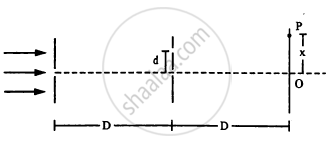
Consider the arrangement shown in the figure. The distance D is large compared to the separation d between the slits.
- Find the minimum value of d so that there is a dark fringe at O.
- Suppose d has this value. Find the distance x at which the next bright fringe is formed.
- Find the fringe-width.
In Young's double-slit experiment, the two slits are separated by a distance of 1.5 mm, and the screen is placed 1 m away from the plane of the slits. A beam of light consisting of two wavelengths of 650 nm and 520 nm is used to obtain interference fringes.
Find the distance of the third bright fringe for λ = 520 nm on the screen from the central maximum.
Wavefront is ______.
A thin circular ring of mass M and radius R is rotating about its axis with a constant angular velocity ω. Two objects each of mass m are attached gently to the opposite ends of diameter of the ring. The ring will now rotate with an angular velocity:
In Young's double-slit experiment, the screen is moved away from the plane of the slits. What will be its effect on the following?
- The angular separation of the fringes.
- Fringe-width.
What is the fringe width \(\beta\) in Young's double-slit experiment?
What happens to fringe width when the screen distance increases while wavelength and slit separation remain unchanged?
