Advertisements
Advertisements
प्रश्न
(i) In Young's double-slit experiment, deduce the condition for (a) constructive and (b) destructive interferences at a point on the screen. Draw a graph showing variation of intensity in the interference pattern against position 'x' on the screen.
(b) Compare the interference pattern observed in Young's double-slit experiment with single-slit diffraction pattern, pointing out three distinguishing features.
Advertisements
उत्तर
Expression for Fringe Width in Young’s Double-Slit Experiment
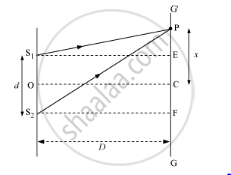
Let S1 and S2 be two slits separated by a distance d. `GG'` is the screen at a distance D from the slits S1and S2. Point C is equidistant from both the slits. The intensity of light will be maximum at this point because the path difference of the waves reaching this point will be zero.
At point P, the path difference between the rays coming from the slits is given by
S1= S2P − S1P
Now, S1 S2 = d, EF = d, and S2F = D
In ΔS2PF,
`S_2P=[S_2F^2+PF^2]^(1/2)`
`S_2P=[D2+(x+d/2)^2]^(1/2)`
`=D[1+(x+d/2)^2/D^2]^(1/2)`
Similarly, in ΔS1PE
`S_1P=D[1+(x-d/2)^2/D^2]^(1/2)`
`:.S_2P-S_1P=D[1+1/2(x+d/2)^2/D^2)]-D[1+1/2(x-d/2)^2/D^2]`
On expanding it binomially, we get
`S_2P-S_1P=1/(2D)[4xd/2]=(xd)/D`
For constructive interference, the path difference is an integral multiple of wavelengths, that is, path difference is nλ.
`:.nlambda=(xd)/D`
`x=(nlambdaD)/d`
where n = 0, 1, 2, 3, 4, …
Similarly, for destructive interference,
`x_n=(2n-1)lambda/2D/d`
Graph of Intensity Distribution in Young’s Double-Slit Experiment
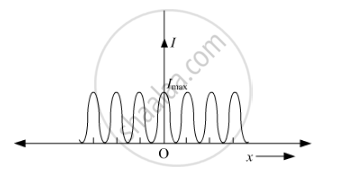
(ii) On comparing the interference pattern observed in Young's double slit experiment (interference) with single-slit diffraction pattern (diffraction), we can have three distinguishing features:
In the interference pattern, all the bright fringes have the same intensity. In a diffraction pattern, all the bright fringes are not of the same intensity
In the interference pattern, the dark fringe has zero or very small intensity so that the bright and dark fringes can easily be distinguished. In diffraction pattern, all the dark fringes are not of zero intensity
In the interference pattern, the widths of all the fringes are almost the same, whereas in diffraction pattern, the fringes are of different widths
संबंधित प्रश्न
What is the effect on the fringe width if the distance between the slits is reduced keeping other parameters same?
The ratio of the intensities at minima to the maxima in the Young's double slit experiment is 9 : 25. Find the ratio of the widths of the two slits.
Using monochromatic light of wavelength λ in Young’s double slit experiment, the eleventh dark fringe is obtained on the screen for a phase difference of ______.
Explain two features to distinguish between the interference pattern in Young's double slit experiment with the diffraction pattern obtained due to a single slit.
A Young's double slit apparatus has slits separated by 0⋅28 mm and a screen 48 cm away from the slits. The whole apparatus is immersed in water and the slits are illuminated by red light \[\left( \lambda = 700\text{ nm in vacuum} \right).\] Find the fringe-width of the pattern formed on the screen.
"If the slits in Young's double slit experiment are identical, then intensity at any point on the screen may vary between zero and four times to the intensity due to single slit".
Justify the above statement through a relevant mathematical expression.
The Young's double slit experiment is performed with blue and with green light of wavelengths 4360Å and 5460Å respectively. If x is the distance of 4th maxima from the central one, then:
A slit of width 0.6 mm is illuminated by a beam of light consisting of two wavelengths 600 nm and 480 nm. The diffraction pattern is observed on a screen 1.0 m from the slit. Find:
- The distance of the second bright fringe from the central maximum pertaining to the light of 600 nm.
- The least distance from the central maximum at which bright fringes due to both wavelengths coincide.
In Young's double slit experiment using light of wavelength 600 nm, the slit separation is 0.8 mm and the screen is kept 1.6 m from the plane of the slits. Calculate
- the fringe width
- the distance of (a) third minimum and (b) fifth maximum, from the central maximum.
The central fringe of the interference pattern produced by the light of wavelength 6000 Å is found to shift to the position of the fourth bright fringe after a glass plate of refractive index 1.5 is introduced in the path of one of the beams. The thickness of the glass plate would be ______.
