Advertisements
Advertisements
Question
In a Young's double slit interference experiment, the fringe pattern is observed on a screen placed at a distance D from the slits. The slits are separated by a distance d and are illuminated by monochromatic light of wavelength \[\lambda.\] Find the distance from the central point where the intensity falls to (a) half the maximum, (b) one-fourth the maximum.
Advertisements
Solution
Given:-
Separation between the two slits = d
Wavelength of the light = \[\lambda\]
Distance of the screen = D
(a) When the intensity is half the maximum:-
Let Imax be the maximum intensity and I be the intensity at the required point at a distance y from the central point.
So,
\[I = a^2 + a^2 + 2 a^2 \cos\phi\]
Here, \[\phi\] is the phase difference in the waves coming from the two slits.
So, \[I = 4 a^2 \cos^2 \left( \frac{\phi}{2} \right)\]
\[\Rightarrow \frac{I}{I_\max} = \frac{1}{2}\]
\[ \Rightarrow \frac{4 a^2 \cos^2 \left( \frac{\phi}{2} \right)}{4 a^2} = \frac{1}{2}\]
\[ \Rightarrow \cos^2 \left( \frac{\phi}{2} \right) = \frac{1}{2}\]
\[ \Rightarrow \cos\left( \frac{\phi}{2} \right) = \frac{1}{\sqrt{2}}\]
\[ \Rightarrow \frac{\phi}{2} = \frac{\pi}{4}\]
\[ \Rightarrow \phi = \frac{\pi}{2}\]
Corrosponding path difference, \[∆ x = \frac{\lambda}{4}\]
\[ \Rightarrow y = \frac{∆ xD}{d} = \frac{\lambda D}{4d}\]
(b) When the intensity is one-fourth of the maximum:-
\[\frac{I}{I_\max} = \frac{1}{4}\]
\[ \Rightarrow 4 a^2 \cos^2 \left( \frac{\phi}{2} \right) = \frac{1}{4}\]
\[ \Rightarrow \cos^2 \left( \frac{\phi}{2} \right) = \frac{1}{4}\]
\[ \Rightarrow \cos\left( \frac{\phi}{2} \right) = \frac{1}{2}\]
\[ \Rightarrow \frac{\phi}{2} = \frac{\pi}{3}\]
So, corrosponding path difference, \[∆ x = \frac{\lambda}{3}\]
and position, \[y = \frac{∆ xD}{d} = \frac{\lambda D}{3d}.\]
APPEARS IN
RELATED QUESTIONS
What is the effect on the fringe width if the distance between the slits is reduced keeping other parameters same?
In Young's double slit experiment, describe briefly how bright and dark fringes are obtained on the screen kept in front of a double slit. Hence obtain the expression for the fringe width.
In a Young’s double-slit experiment, the slits are separated by 0.28 mm and the screen is placed 1.4 m away. The distance between the central bright fringe and the fourth bright fringe is measured to be 1.2 cm. Determine the wavelength of light used in the experiment.
In Young’s double slit experiment, show graphically how the intensity of light varies with distance
Two polaroids ‘A’ and ‘B’ are kept in crossed position. How should a third polaroid ‘C’ be placed between them so that the intensity of polarized light transmitted by polaroid B reduces to 1/8th of the intensity of unpolarized light incident on A?
If the separation between the slits in a Young's double slit experiment is increased, what happens to the fringe-width? If the separation is increased too much, will the fringe pattern remain detectable?
In a double slit interference experiment, the separation between the slits is 1.0 mm, the wavelength of light used is 5.0 × 10⁻⁷ m and the distance of the screen from the slits is 1.0m. (a) Find the distance of the centre of the first minimum from the centre of the central maximum. (b) How many bright fringes are formed in one centimetre width on the screen?
A mica strip and a polystyrene strip are fitted on the two slits of a double slit apparatus. The thickness of the strips is 0.50 mm and the separation between the slits is 0.12 cm. The refractive index of mica and polystyrene are 1.58 and 1.55, respectively, for the light of wavelength 590 nm which is used in the experiment. The interference is observed on a screen at a distance one metre away. (a) What would be the fringe-width? (b) At what distance from the centre will the first maximum be located?
Two transparent slabs having equal thickness but different refractive indices µ1 and µ2are pasted side by side to form a composite slab. This slab is placed just after the double slit in a Young's experiment so that the light from one slit goes through one material and the light from the other slit goes through the other material. What should be the minimum thickness of the slab so that there is a minimum at the point P0 which is equidistant from the slits?
A parallel beam of monochromatic light is used in a Young's double slit experiment. The slits are separated by a distance d and the screen is placed parallel to the plane of the slits. Slow that if the incident beam makes an angle \[\theta = \sin^{- 1} \left( \frac{\lambda}{2d} \right)\] with the normal to the plane of the slits, there will be a dark fringe at the centre P0 of the pattern.
Consider the arrangement shown in the figure. By some mechanism, the separation between the slits S3 and S4 can be changed. The intensity is measured at the point P, which is at the common perpendicular bisector of S1S2 and S2S4. When \[z = \frac{D\lambda}{2d},\] the intensity measured at P is I. Find the intensity when z is equal to
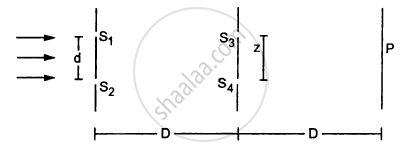
(a) \[\frac{D\lambda}{d}\]
(b) \[\frac{3D\lambda}{2d}\] and
(c) \[\frac{2D\lambda}{d}\]
How is the fringe width of an interference pattern in Young's double-slit experiment affected if the two slits are brought closer to each other?
In Young’s double-slit experiment, show that:
`beta = (lambda "D")/"d"` where the terms have their usual meaning.
"If the slits in Young's double slit experiment are identical, then intensity at any point on the screen may vary between zero and four times to the intensity due to single slit".
Justify the above statement through a relevant mathematical expression.
Two balls are projected at an angle θ and (90° − θ) to the horizontal with the same speed. The ratio of their maximum vertical heights is:
Consider a two-slit interference arrangement (Figure) such that the distance of the screen from the slits is half the distance between the slits. Obtain the value of D in terms of λ such that the first minima on the screen falls at a distance D from the centre O.

ASSERTION (A): In an interference pattern observed in Young's double slit experiment, if the separation (d) between coherent sources as well as the distance (D) of the screen from the coherent sources both are reduced to 1/3rd, then new fringe width remains the same.
REASON (R): Fringe width is proportional to (d/D).
In Young's double slit experiment the two slits are 0.6 mm distance apart. Interference pattern is observed on a screen at a distance 80 cm from the slits. The first dark fringe is observed on the screen directly opposite to one of the slits. The wavelength of light will be ______ nm.
For small angles, what is the approximate path difference at a point a distance \(x\) from the central bright fringe?
