Advertisements
Advertisements
प्रश्न
A group of students while coming from the school noticed a box marked "Danger H.T. 2200 V" at a substation in the main street. They did not understand the utility of a such a high voltage, while they argued, the supply was only 220 V. They asked their teacher this question the next day. The teacher thought it to be an important question and therefore explained to the whole class.
Answer the following questions:
(i) What device is used to bring the high voltage down to low voltage of a.c. current and what is the principle of its working ?
(ii) Is it possible to use this device for bringing down the high dc voltage to the low voltage? Explain
(iii) Write the values displayed by the students and the teacher.
Advertisements
उत्तर
(i) The device that is used to bring high voltage down to low voltage of an a.c. current is a transformer. It works on the principle of mutual induction of two windings or circuits. When current in one circuit changes, emf is induced in the neighbouring circuit.
(ii) The transformer cannot convert d.c. voltages because it works on the principle of mutual induction. When the current linked with the primary coil changes, the magnetic flux linked with the secondary coil also changes. This change in flux induces emf in the secondary coil. If we apply a direct current to the primary coil, the current will remain constant. Thus, there is no mutual induction, and hence no emf is induced.
(iii) The value of gaining knowledge and curiosity about learning new things is being displayed by the students. The value of providing good education and undertaking the doubts of students has been displayed by the teacher.
APPEARS IN
संबंधित प्रश्न
Write the function of a transformer.
The following diagram in Fig. 10.44 shows a coil X connected to a sensitive centre –zero galvanometer G and a coil P connected to a battery through a switch S.
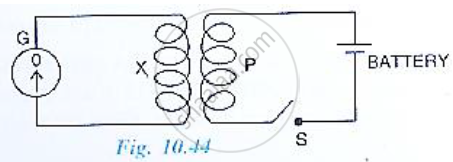
(a) Describe the observation when the switch S is (i) closed suddenly, (ii) then kept closed, (iii) finally opened.
(b) Name and state the law which explains the above observations.
(i) Draw a clear labelled diagram of an electric bell.
(ii) Explain in brief, its working.
(iii) What material is used for the core of an electric bell? State the reason.
Assertion: A transfonner cannot work on D.C. supply.
Reason: D.C. changes neither in magnitude nor in direction.
Read the following paragraph and answer the question:

Long distance power transmissions
The large-scale transmission and distribution of electrical energy over long distances is done with the use of transformers. The voltage output of the generator is stepped up. It is then transmitted over long distances to an area sub-station near the consumers. There the voltage is stepped down. It is further stepped down at distributing sub-stations and utility poles before a power supply of 240 V reaches our homes.
We need to step-up the voltage for power transmission, so that ______.
Define a Transformer.
1 MW power is to be delivered from a power station to a town 10 km away. One uses a pair of Cu wires of radius 0.5 cm for this purpose. Calculate the fraction of ohmic losses to power transmitted if
- power is transmitted at 220 V. Comment on the feasibility of doing this.
- a step-up transformer is used to boost the voltage to 11000 V, power transmitted, then a step-down transfomer is used to bring voltage to 220 V. (ρCu = 1.7 × 10⁻⁸ SI unit)
An ideal transformer converts 220 V a.c. to 3.3 kV a.c. to transmit a power of 4.4 kW. If primary coil has 600 turns, then alternating current in secondary coil is ______.
Derive the equation for a transformer.
In an ideal transformer, the turns ratio is `N_p/N_s = 1/2`. The ratio Vs : Vp is equal to (the symbols carry their usual meaning):
