Advertisements
Advertisements
प्रश्न
The primary coil of an ideal step-up transformer has 100 turns and the transformation ratio is also 100. The input voltage and power are 220 V and 1100 W, respectively. Calculate the
(a) number of turns in secondary
(b) current in the primary
(c) a voltage across secondary
(d) current in secondary
(e) power in secondary
Advertisements
उत्तर
(a) Number of turns in secondary coil is given by
`N_S/N_P=n`
`=>N_S/100=100`
⇒NS=10,000
(b) Current in primary is given by
IPVP=P
`=>I_P=1100/220=5A`
(c) Voltage across secondary is given by
`V_S/V_P=N_S/N_P=n`
⇒VS=100×220=22,000 V
(d) Current in secondary is given by
VSIS=P
`=>I_S=P/V_S=1100/22000=0.05A`
(e) Power in secondary is power in primary in an ideal transformer.
= 1,100 W
संबंधित प्रश्न
A power transmission line feeds input power at 2200 V to a step-down transformer with its primary windings having 300 turns. Find the number of turns in the secondary to get the power output at 220 V.
The following diagram in Fig. 10.44 shows a coil X connected to a sensitive centre –zero galvanometer G and a coil P connected to a battery through a switch S.
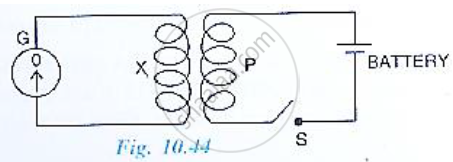
(a) Describe the observation when the switch S is (i) closed suddenly, (ii) then kept closed, (iii) finally opened.
(b) Name and state the law which explains the above observations.
The input and output voltages of a transformer are 220 V and 44V respectively. Find the current in input circuit if the output current is 2 A.
Applying e.m. f to primary coil is 210 V. If the number of turns in primary coil is 200 turns and that of in secondary coil is 20 turns, then find out the output voltage. Name the type of transformer.
A circular coil of 100 turns with a cross-sectional area of 1 m2 is kept with its plane perpendicular to the magnetic field of 1 T. The magnetic flux linkage is ______.
Which among the following, is not a cause for power loss in a transformer?
The primary coil of a transformer has 60 turns whereas its secondary coil has 3000 turns.
If a 220 V ac voltage is applied to the primary coil, how much emf is induced in the secondary coil?
Derive the equation for a transformer.
Which description of the secondary coil is correct?
Where is alternating voltage \[V_p\] applied?
