Advertisements
Advertisements
प्रश्न
Copy the given diagram of a transformer and complete it. Name the parts A and B. Name the part you have drawn to complete the diagram. What is the material of this part? Is this transformer a step-up or step-down? Give reason.
Advertisements
उत्तर
The completed diagram is given below:
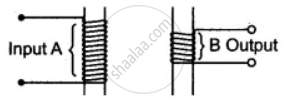
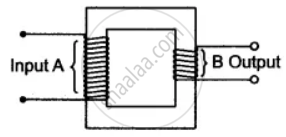
Part A is called primary coil. Part B is called a secondary coil.
The part drawn is called core.
The material of the core is soft iron.
(i) This transformer is step-down since it has more turns in the primary coil than in secondary coil.
(ii) A step-up transformer has more turns in secondary coil as compared to that in the primary coil, while a step-down transformer has more turns in primary coil as compared to that in secondary coil.
(iii) In a step-up transformer the wire in the primary coil is thicker as compared to that in secondary coil, while in a step-down transformer the wire in secondary coil is thicker as compared to that in primary coil.
संबंधित प्रश्न
Derive an expression for e.m.f. and current in terms of turns ratio
Complete the following sentence :
……… energy is converted into …………energy by an electric motor.
In an ideal transformer, an output of 66 kV is required when an input voltage of 220 V is available. If the primary has 300 turns, how many turns should the secondary have?
Explain step up and step down transformer?
A power transmission line feeds input power at 2300 V to a stepdown transformer with its primary windings having 4000 turns. What should be the number of turns in the secondary in order to get output power at 230 V?
A step down transformer connected to an ac mains supply of 220 V is made to operate at 11 V, 44 W lamp. Ignoring power losses in the transformer, what is the current in the primary circuit?
1 MW power is to be delivered from a power station to a town 10 km away. One uses a pair of Cu wires of radius 0.5 cm for this purpose. Calculate the fraction of ohmic losses to power transmitted if
- power is transmitted at 220 V. Comment on the feasibility of doing this.
- a step-up transformer is used to boost the voltage to 11000 V, power transmitted, then a step-down transfomer is used to bring voltage to 220 V. (ρCu = 1.7 × 10⁻⁸ SI unit)
The self-inductance of a closely wound coil of 200 turns is 10 mH. Determine the value of magnetic flux through the cross-section of the coil when the current passing through the coil is 4 mA.
Derive the equation for a transformer.
Which winding is the input coil connected to the AC source?
