Advertisements
Advertisements
प्रश्न
Copy the given diagram of a transformer and complete it. Name the parts A and B. Name the part you have drawn to complete the diagram. What is the material of this part? Is this transformer a step-up or step-down? Give reason.
Advertisements
उत्तर
The completed diagram is given below:
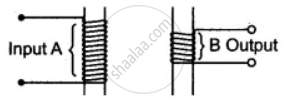
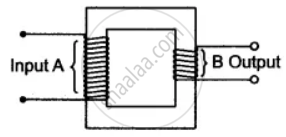
Part A is called primary coil. Part B is called a secondary coil.
The part drawn is called core.
The material of the core is soft iron.
(i) This transformer is step-down since it has more turns in the primary coil than in secondary coil.
(ii) A step-up transformer has more turns in secondary coil as compared to that in the primary coil, while a step-down transformer has more turns in primary coil as compared to that in secondary coil.
(iii) In a step-up transformer the wire in the primary coil is thicker as compared to that in secondary coil, while in a step-down transformer the wire in secondary coil is thicker as compared to that in primary coil.
संबंधित प्रश्न
The input and output voltages of a transformer are 220 V and 44V respectively. Find the current in input circuit if the output current is 2 A.
Can a transformer be used with direct current source? Give reason.
Explain step up and step down transformer?
Give the advantage of AC in long distance power transmission with an illustration.
Assertion: A transfonner cannot work on D.C. supply.
Reason: D.C. changes neither in magnitude nor in direction.
Name one electrical device which works on Faraday's law of electromagnetic induction principle.
The primary winding of a transformer has 100 turns and its secondary winding has 200 turns. The primary is connected to an a.c supply of 120 V and the current flowing in its is 10 A. The voltage and the current in the secondary are ______.
A 12 V, 60 W lamp is connected to 220 V AC via an ideal transformer. Find the primary current.
Which description of the primary coil is correct?
