Advertisements
Advertisements
Question
Copy the given diagram of a transformer and complete it. Name the parts A and B. Name the part you have drawn to complete the diagram. What is the material of this part? Is this transformer a step-up or step-down? Give reason.
Advertisements
Solution
The completed diagram is given below:
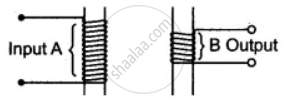
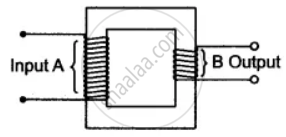
Part A is called primary coil. Part B is called a secondary coil.
The part drawn is called core.
The material of the core is soft iron.
(i) This transformer is step-down since it has more turns in the primary coil than in secondary coil.
(ii) A step-up transformer has more turns in secondary coil as compared to that in the primary coil, while a step-down transformer has more turns in primary coil as compared to that in secondary coil.
(iii) In a step-up transformer the wire in the primary coil is thicker as compared to that in secondary coil, while in a step-down transformer the wire in secondary coil is thicker as compared to that in primary coil.
RELATED QUESTIONS
A group of students while coming from the school noticed a box marked "Danger H.T. 2200 V" at a substation in the main street. They did not understand the utility of a such a high voltage, while they argued, the supply was only 220 V. They asked their teacher this question the next day. The teacher thought it to be an important question and therefore explained to the whole class.
Answer the following questions:
(i) What device is used to bring the high voltage down to low voltage of a.c. current and what is the principle of its working ?
(ii) Is it possible to use this device for bringing down the high dc voltage to the low voltage? Explain
(iii) Write the values displayed by the students and the teacher.
Explain the significance of Lenz’s law to show the conservation of energy in electromagnetic induction.
In an ideal transformer, an output of 66 kV is required when an input voltage of 220 V is available. If the primary has 300 turns, how many turns should the secondary have?
The primary and secondary coils of a transformer each have an inductance of 200 x 10-6 H. The mutual inductance between the windings is 4 x 10⁻⁶ H. What percentage of the flux from one coil reaches the other?
The large scale transmission of electrical energy over long distances is done with the use of transformers. The voltage output of the generator is stepped-up because of ______.
In an ideal transformer, the turns ratio is \[\frac {N_p}{N_s}\] = \[\frac {1}{2}\]. The ratio Vs : Vp is equal to (the symbols carry their usual meaning) ______.
On which principle is a transformer based?
What does the laminated soft iron core provide for the flux?
Which description of the primary coil is correct?
What is the induced EMF in the primary coil?
