हिंदी

Describe Briefly, with the Help of Labelled Diagram, Working of a Step-up Transformer. a Step-up Transformer Converts a Low Voltage into High Voltage. Does It Not Violate the Principle of - Physics

Advertisements
Advertisements

प्रश्न

Describe briefly, with the help of labelled diagram, working of a step-up transformer.

A step-up transformer converts a low voltage into high voltage. Does it not violate the principle of conservation of energy? Explain.

Advertisements

उत्तर
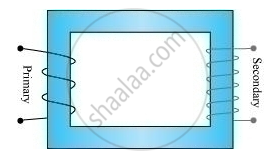
In a transformer with Ns secondary turns and Npprimary turns, induced emf or voltage Es is:

`E_s = -N_s (dphi)/dt`

Back emf = Ep =`-N_p(dphi)/(dt)`

EP = VP

Es = Vs

Thus, Vs = `-N_s (dphi)/()dt`… (1)

`V_p =-N_p (dphi)/dt     ... (2)`

Dividing equations (i) and (ii), we obtain

`(V_s)/(V_p) = N_s/N_p` 

If the transformer is 100% efficient, then

`i_p v_p = i_s v_s` = Power (p)

Thus, combining the above equations,

`i_p/i_s = v_s/v_p = N_s/N_p`

Or,

`V_s = (N_s/N_p)V_p and I_s = (N_p/N_s) I_p`

If Ns > Np, then the transformer is said to be step-up transformer because the voltage is stepped up in the secondary coil.

No, the transformer does not violate the principal of conservation of energies. This can be easily observed by the following equation:

`V_s I_s =V_pI_p`

Power consumed in both the coils is the same as even if the voltage increases or current increases, their product at any instant remains the same.

shaalaa.com
  क्या इस प्रश्न या उत्तर में कोई त्रुटि है?
2008-2009 (March) Delhi set 1

वीडियो ट्यूटोरियलVIEW ALL [3]

संबंधित प्रश्न

The adjacent diagram shows a coil would around a soft iron bar XY. (a) State the polarity at the end X and Y as the switch is pressed. (b) Suggest one way increasing the strength of electromagnet so formed.


Explain the significance of Lenz’s law to show the conservation of energy in electromagnetic induction.


Name two kind of energy loss in a transformer. How is it minimized?


A transformer lowers e.m.f. from 220 V to 15 V. If 400 W power is given in primary, calculate (i) the current in primary coil and (ii) the current in secondary coil.


A 200V/120V step-down transformer of 90% efficiency is connected to an induction stove of resistance 40 Ω. Find the current drawn by the primary of the transformer.


A transformer is based on the principle of ______.

A transformer is essentially an a.c. device. It cannot work on d.c. It changes alternating voltages or currents. It does not affect the frequency of a.c. It is based on the phenomenon of mutual induction. A transformer essentially consists of two coils of insulated copper wire having different numbers of turns and wound on the same soft iron core.

The number of turns in the primary and secondary coils of an ideal transformer is 2000 and 50 respectively. The primary coil is connected to a main supply of 120 V and secondary coil is connected to a bulb of resistance 0.6 Ω.

The value of current in the bulb is ______.


1 MW power is to be delivered from a power station to a town 10 km away. One uses a pair of Cu wires of radius 0.5 cm for this purpose. Calculate the fraction of ohmic losses to power transmitted if

  1. power is transmitted at 220 V. Comment on the feasibility of doing this.
  2. a step-up transformer is used to boost the voltage to 11000 V, power transmitted, then a step-down transfomer is used to bring voltage to 220 V. (ρCu = 1.7 × 10⁻⁸ SI unit)

The primary coil of a transformer has 60 turns whereas its secondary coil has 3000 turns.

If a current of 5A flows in the primary coil, how much current will flow in a load in the secondary coil? State the assumption you have made regarding the transformer, in this calculation.


A step down transformer connected to an ac mains supply of 220 V is made to operate at 11 V, 44 W lamp. Ignoring power losses in the transformer, what is the current in the primary circuit?


Share
Notifications

Englishहिंदीमराठी


      Forgot password?
Use app×