Advertisements
Advertisements
Question
Describe briefly, with the help of labelled diagram, working of a step-up transformer.
A step-up transformer converts a low voltage into high voltage. Does it not violate the principle of conservation of energy? Explain.
Advertisements
Solution
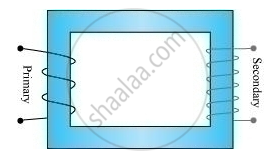
In a transformer with Ns secondary turns and Npprimary turns, induced emf or voltage Es is:
`E_s = -N_s (dphi)/dt`
Back emf = Ep =`-N_p(dphi)/(dt)`
EP = VP
Es = Vs
Thus, Vs = `-N_s (dphi)/()dt`… (1)
`V_p =-N_p (dphi)/dt ... (2)`
Dividing equations (i) and (ii), we obtain
`(V_s)/(V_p) = N_s/N_p`
If the transformer is 100% efficient, then
`i_p v_p = i_s v_s` = Power (p)
Thus, combining the above equations,
`i_p/i_s = v_s/v_p = N_s/N_p`
Or,
`V_s = (N_s/N_p)V_p and I_s = (N_p/N_s) I_p`
If Ns > Np, then the transformer is said to be step-up transformer because the voltage is stepped up in the secondary coil.
No, the transformer does not violate the principal of conservation of energies. This can be easily observed by the following equation:
`V_s I_s =V_pI_p`
Power consumed in both the coils is the same as even if the voltage increases or current increases, their product at any instant remains the same.
APPEARS IN
RELATED QUESTIONS
Explain the construction and working of the transformer.
A transformer converts 240 V AC to 60 V AC. The secondary has 75 turns. The number of turns in primary are _______.
(A) 600
(B) 500
(C) 400
(D) 300
The primary coil of an ideal step-up transformer has 100 turns and the transformation ratio is also 100. The input voltage and power are 220 V and 1100 W, respectively. Calculate the
(a) number of turns in secondary
(b) current in the primary
(c) a voltage across secondary
(d) current in secondary
(e) power in secondary
What type of current is transmitted from the power station?
State the factors on which the frequency of the alternating e.m.f. depends.
State the mathematical relation between a number of turns in the primary coil to a secondary coil in the step-up transformer.
Give the advantage of AC in long distance power transmission with an illustration.
The 300 turn primary of a transformer has resistance 0.82 Ω and the resistance of its secondary of 1200 turns is 6.2 Ω. Find the voltage across the primary if the power output from the secondary at 1600V is 32 kW. Calculate the power losses in both coils when the transformer efficiency is 80%
A transformer having efficiency of 80% is working on 200 V and 6 kW power supply. If the current in the secondary coil is 6 A, the voltage across the secondary coil and the current in the primary coil respectively are ____________.
