Advertisements
Advertisements
Question
For an LCR circuit, the power transferred from the driving source to the driven oscillator is P = I2Z cos φ.
- Here, the power factor cos φ ≥ 0, P ≥ 0.
- The driving force can give no energy to the oscillator (P = 0) in some cases.
- The driving force cannot syphon out (P < 0) the energy out of oscillator.
- The driving force can take away energy out of the oscillator.
Options
a, b and c
a, b and d
b, c and d
c and d
Advertisements
Solution
a, b and c
Explanation:
As per question P = I2Z cos `phi`P = I2Z cos `phi`
Power factor cos `phi` = RZ cos `phi` = RZ
As R > 0 and Z > 0
So cos `phi` = RZ cos `phi` = RZ is positive ⇒ P > 0
APPEARS IN
RELATED QUESTIONS
State the principle on which transformer works.
Explain why an induced current must flow in such a direction so as to oppose the change producing it.
The following diagram in Fig. 10.44 shows a coil X connected to a sensitive centre –zero galvanometer G and a coil P connected to a battery through a switch S.
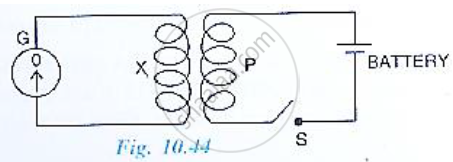
(a) Describe the observation when the switch S is (i) closed suddenly, (ii) then kept closed, (iii) finally opened.
(b) Name and state the law which explains the above observations.
Name two kind of energy loss in a transformer. How is it minimized?
State the underlying principle of a transformer. How is the large scale transmission of electric energy over long distances done with the use of transformers?
State the principle of working of a transformer. Can a transformer be used to step up or step down a d.c. voltage? Justify your answer.
An a.c generator generates an emf 'ε' where ε = 314 Sin (50πt) volt. Calculate the frequency of emf ε.
A circular coil of 100 turns with a cross-sectional area of 1 m2 is kept with its plane perpendicular to the magnetic field of 1 T. The magnetic flux linkage is ______.
The 300 turn primary of a transformer has resistance 0.82 Ω and the resistance of its secondary of 1200 turns is 6.2 Ω. Find the voltage across the primary if the power output from the secondary at 1600V is 32 kW. Calculate the power losses in both coils when the transformer efficiency is 80%
The output power in step-up transformer used in practice is ______.
The primary coil of a transformer has 800 turns and the secondary coil has 8 turns. It is connected to a 220 V ac supply. What will be the output voltage?
1 MW power is to be delivered from a power station to a town 10 km away. One uses a pair of Cu wires of radius 0.5 cm for this purpose. Calculate the fraction of ohmic losses to power transmitted if
- power is transmitted at 220 V. Comment on the feasibility of doing this.
- a step-up transformer is used to boost the voltage to 11000 V, power transmitted, then a step-down transfomer is used to bring voltage to 220 V. (ρCu = 1.7 × 10⁻⁸ SI unit)
In a transformer, number of turns in the primary coil are 140 and that in the secondary coil are 280. If current in primary coil is 4 A, then that in the secondary coil is ______.
Magnetic flux passing through a coil is initially 4 × 10⁻⁴ Wb. It reduces to 10% of its original value in t second. If the emf induced is 0. 72 mV then t in second is ______.
Explain why core of a transformer is always laminated.
An ideal transformer converts 170 V a.c. to 1.70 KV a.c. to transmit a power of 3.4 KW. If primary coil has 500 turns then alternating current in secondary coil is ______.
What does the primary coil draw from the source?
Assuming no flux leakage, which coils does the changing flux thread through?
What is the induced EMF in the secondary coil?
