Advertisements
Advertisements
Question
When an AC voltage of 220 V is applied to the capacitor C ______.
- the maximum voltage between plates is 220 V.
- the current is in phase with the applied voltage.
- the charge on the plates is in phase with the applied voltage.
- power delivered to the capacitor is zero.
Options
b and c
a and d
b and d
c and d
Advertisements
Solution
c and d
Explanation:
If the alternating voltage is applied to the capacitor, the plate connected to the positive terminal of the source will be at a higher potential and the plate connected to the negative terminal of the source will be at a lower potential. So the plate's capacitor is charged.

Power applied to circuit is `P_(av) = V_(rms) I_(rms) cos phi`
`phi` = 90° for pure capacitor circuit
∴ Pav = Vrms Irms cos 90° = 0.
APPEARS IN
RELATED QUESTIONS
A capacitor acts as an infinite resistance for ______.
A device Y is connected across an AC source of emf e = e0 sin ωt. The current through Y is given as i = i0 sin (ωt + π/2).
- Identify the device Y and write the expression for its reactance.
- Draw graphs showing a variation of emf and current with time over one cycle of AC for Y.
- How does the reactance of the device Y vary with the frequency of the AC? Show graphically.
- Draw the phasor diagram for device Y.
A.C. power is transmitted from a power house at a high voltage as ______.
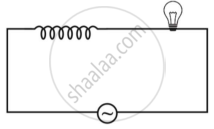
An iron cored coil is connected in series with an electric bulb with an AC source as shown in figure. When iron piece is taken out of the coil, the brightness of the bulb will ______.
An a.c. source generating a voltage ε = ε0 sin ωt is connected to a capacitor of capacitance C. Find the expression for the current I flowing through it. Plot a graph of ε and I versus ωt to show that the current is ahead of the voltage by π/2.
A resistor of 50 Ω, a capacitor of `(25/pi)` µF and an inductor of `(4/pi)` H are connected in series across an ac source whose voltage (in volts) is given by V = 70 sin (100 πt). Calculate:
- the net reactance of the circuit
- the impedance of the circuit
- the effective value of current in the circuit.
A 40 µF capacitor is connected to a 200 V. 50 Hz ac supply. The rms value of the current on the circuit is, nearly ______.
When an AC voltage of 220 V is applied to the capacitor C ______.
The resistance of a coil for d.c. is 5 Ω. In a.c., the resistance will ______.
What is the charge on the capacitor at time \[t\]?
What is the peak current in a capacitor connected to an AC source?
What is the capacitive reactance of a capacitor?
What is the average power over one complete cycle for a capacitor connected to an AC source?
What happens to the current after a capacitor has charged from a DC source?
How does a lamp in series with a capacitor behave when connected to an AC source?
What happens to the capacitive reactance if the frequency is doubled while capacitance stays the same?
