Advertisements
Advertisements
Question
The line that draws power supply to your house from street has ______.
- zero average current.
- 220 V average voltage.
- voltage and current out of phase by 90°.
- voltage and current possibly differing in phase `phi` such that `|phi| < pi/2`.
Options
b and c
a and d
b and d
a and c
Advertisements
Solution
a and d
Explanation:
Alternating currents are used for household supplies, which are having zero average value over a cycle.
The line is having some resistance, so power factor `cos phi = R/Z ≠ 0`
So, `phi = pi/2 ⇒ phi < pi/2`
i.e., phase lies between 0 and `pi/2`.
Important point: The average value of alternating quantity for one complete cycle is zero.
The average value of ac over half cycle (t = 0 to T/2)
`I_(av) = (int_0^(T/2) i dt)/(int_0^(T/2) dt) = (2i_0)/pi = 0.637i_0` = 63.7% of i0
Similarly `V_(av) = (2V_0)/pi` = 0.637 V0 = 63.7% of V0.
APPEARS IN
RELATED QUESTIONS
Derive an expression for e.m.f. and current in terms of turns ratio
Express the turn ratio in terms of voltages.
How much current is drawn by the primary of a transformer connected to 220 V supply when it delivers power to a 110 V − 550 W refrigerator?
The following diagram in Fig.10.42 shows a coil of several turns of copper wire connected to a sensitive centre zero galvanometer G near a magnet NS. The coil is free to move in the direction shown in the diagram.
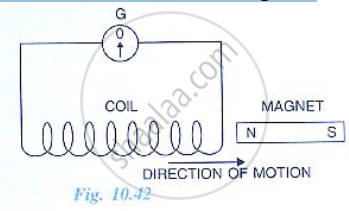
(i) Describe the observation if the coil is rapidly moved.
(ii) How would the observation be altered if (a) the coil has twice as many turns (b the coil was made to move three times as fast?
The transformer is used in ______ current circuits.
In a transformer, the frequency of A.C. voltage ______.
A transformer is designed to work from a 240 V a.c. mains and to give a supply of 8 V to ring a house bell. The primary coil has 4800 turns. How many turns will be in the secondary coil?
What is the turns ratio i.e., transformer ratio, ns: np, in an ideal transformer which in-creases ac voltage from 220 V to 33000 V?
Name the principle on which functioning of a transformer depends.
The primary of a transformer has 40 turns and works on 100 V and 100 W. Find a number of turns in the secondary to step up the voltage to 400 V. Also calculate the current in the secondary and primary.
A transformer is essentially an a.c. device. It cannot work on d.c. It changes alternating voltages or currents. It does not affect the frequency of a.c. It is based on the phenomenon of mutual induction. A transformer essentially consists of two coils of insulated copper wire having different numbers of turns and wound on the same soft iron core.
The number of turns in the primary and secondary coils of an ideal transformer is 2000 and 50 respectively. The primary coil is connected to a main supply of 120 V and secondary coil is connected to a bulb of resistance 0.6 Ω.
The value of current in primary coil is ______.
A transformer is essentially an a.c. device. It cannot work on d.c. It changes alternating voltages or currents. It does not affect the frequency of a.c. It is based on the phenomenon of mutual induction. A transformer essentially consists of two coils of insulated copper wire having different numbers of turns and wound on the same soft iron core.
The number of turns in the primary and secondary coils of an ideal transformer is 2000 and 50 respectively. The primary coil is connected to a main supply of 120 V and secondary coil is connected to a bulb of resistance 0.6 Ω.
Power in primary coil is ______.
Electrical energy is transmitted over large distances at high alternating voltages. Which of the following statements is (are) correct?
- For a given power level, there is a lower current.
- Lower current implies less power loss.
- Transmission lines can be made thinner.
- It is easy to reduce the voltage at the receiving end using step-down transformers.
The large scale transmission of electrical energy over long distances is done with the use of transformers. The voltage output of the generator is stepped-up because of ______.
What is a transformer?
In an ideal transformer, the turns ratio is \[\frac {N_p}{N_s}\] = \[\frac {1}{2}\]. The ratio Vs : Vp is equal to (the symbols carry their usual meaning) ______.
A 12 V, 60 W lamp is connected to a 220 V AC supply using an ideal transformer. Find the primary current.
A 12 V, 60 W lamp is connected to 220 V AC via an ideal transformer. Find the primary current.
Why is soft iron used in the core?
For an ideal transformer with \[\frac{V_s}{V_p}=3\], what is \[\frac{I_p}{I_s}\]?
