Advertisements
Advertisements
Question
An ideal transformer has 100 turns in the primary and 250 turns in the secondary. The peak value of the AC is 28 V. The rms secondary voltage is nearest to ______
Options
100 V
70 V
50 V
40 V`
Advertisements
Solution
An ideal transformer has 100 turns in the primary and 250 turns in the secondary. The peak value of the AC is 28 V. The rms secondary voltage is nearest to 50 V.
APPEARS IN
RELATED QUESTIONS
State the principle on which transformer works.
Explain the construction and working of the transformer.
Draw a labeled diagram of a step-down transformer.
A group of students while coming from the school noticed a box marked "Danger H.T. 2200 V" at a substation in the main street. They did not understand the utility of a such a high voltage, while they argued, the supply was only 220 V. They asked their teacher this question the next day. The teacher thought it to be an important question and therefore explained to the whole class.
Answer the following questions:
(i) What device is used to bring the high voltage down to low voltage of a.c. current and what is the principle of its working ?
(ii) Is it possible to use this device for bringing down the high dc voltage to the low voltage? Explain
(iii) Write the values displayed by the students and the teacher.
Derive an expression for e.m.f. and current in terms of turns ratio
Which coil of a step up transformer is made thicker and why?
Name two factors on which the magnitude of an induced e.m.f. in the secondary coil depends.
The teachers of Geeta’s school took the students on a study trip to a power generating station, located nearly 200 km away from the city. The teacher explained that electrical energy is transmitted over such a long distance to their city, in the form of alternating current (ac) raised to a high voltage. At the receiving end in the city, the voltage is reduced to operate the devices. As a result, the power loss is reduced. Geeta listened to the teacher and asked questions about how the ac is converted to a higher or lower voltage.
1) Name the device used to change the alternating voltage to a higher or lower value. State one cause for power dissipation in this device.
2) Explain with an example, how power loss is reduced if the energy is transmitted over long distances as an alternating current rather than a direct current.
3) Write two values each shown by the teachers and Geeta.
You are required to make an electromagnet from a soft iron bar by using a cell, an insulated coil of copper wire and a switch. (a) Draw a circuit diagram to represent the process. (b) label the poles of the electromagnet.
The following diagram in Fig. 10.44 shows a coil X connected to a sensitive centre –zero galvanometer G and a coil P connected to a battery through a switch S.
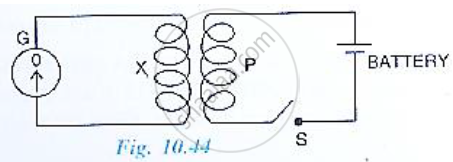
(a) Describe the observation when the switch S is (i) closed suddenly, (ii) then kept closed, (iii) finally opened.
(b) Name and state the law which explains the above observations.
How are the e.m.f in the primary and secondary coils of a transformer related with the number of turns in these coils?
The secondary windings of a transformer in which the voltage is stepped down are usually made of thicker wire than the primary. Explain why.
Why is the iron core of a transformer made laminated (thin sheets) instead of being in one solid piece?
The transformer is used in ______ current circuits.
Name two kind of energy loss in a transformer. How is it minimized?
The primary coil of a transformed has 800 urns and the secondary coil has 8 turns. It is connected to a 220 V a.c. supply. What will be the output voltage?
State the principle of a step-up transformer. Explain, with the help of a labeled diagram, its working ?
Describe briefly and two energy losses, giving the reasons for their occurrence in actual transformers ?
State the principle of working of a transformer. Can a transformer be used to step up or step down a d.c. voltage? Justify your answer.
An a.c generator generates an emf 'ε' where ε = 314 Sin (50πt) volt. Calculate the frequency of emf ε.
What is the turns ratio i.e., transformer ratio, ns: np, in an ideal transformer which in-creases ac voltage from 220 V to 33000 V?
Name the principle on which functioning of a transformer depends.
Why is the core of a transformer made of soft iron?
Draw a labelled diagram to show the various parts of a step-up transformer and step down transformer.
(i) Draw a clear labelled diagram of an electric bell.
(ii) Explain in brief, its working.
(iii) What material is used for the core of an electric bell? State the reason.
The primary and secondary coils of a transformer each have an inductance of 200 x 10-6 H. The mutual inductance between the windings is 4 x 10⁻⁶ H. What percentage of the flux from one coil reaches the other?
Distinguish between Step up and Step Down Transformer.
The primary of a transformer has 40 turns and works on 100 V and 100 W. Find a number of turns in the secondary to step up the voltage to 400 V. Also calculate the current in the secondary and primary.
Transformer works on ______.
State whether true or false. If false, correct the statement.
A transformer can step up direct current.
In a transformer, the number of turns in the primary and the secondary are 410 and 1230 respectively. If the current in primary is 6A, then that in the secondary coil is
A step-down transformer reduces the supply voltage from 220 V to 11 V and increase the current from 6 A to 100 A. Then its efficiency is
Mention the various energy losses in a transformer.
A step-up transformer has 300 turns of primary winding and 450 turns of secondary winding. A primary is connected to 150 V and the current flowing through it is 9A. The current and voltage in the secondary are
A 220 V input is supplied to a transformer. The output circuit draws a current of 2.0 A at 440 V. If the ratio of output to input power is 0.8, then the current drawn by primary winding is ______.
A power transmission line feeds input power at 2300 V to a stepdown transformer with its primary windings having 4000 turns. What should be the number of turns in the secondary in order to get output power at 230 V?
Define a Transformer.
The primary coil of a transformer has 800 turns and the secondary coil has 8 turns. It is connected to a 220 V ac supply. What will be the output voltage?
A transformer is used ______
A step-down transformer connected to an ac mains supply of 220 V is made to operate at 11 V, 44 W lamp. Ignoring power losses in the transformer, what is the current in the primary circuit?
A 60 W load is connected to the secondary of a transformer whose primary draws line voltage. If a current of 0.54 A flows in the load, what is the current in the primary coil? Comment on the type of transformer being used.
A transformer operating at primary voltage 8 kV and secondary voltage 160 V serves a load of 80 kW. Assuming the transformer to be ideal with purely resistive load and working on unity power factor, the loads in the primary and secondary circuit would be:
Efficiency of transformer is the ratio of ______.
A 12 V, 60 W lamp is connected to 220 V AC via an ideal transformer. Find the primary current.
A step down transformer connected to an ac mains supply of 220 V is made to operate at 11 V, 44 W lamp. Ignoring power losses in the transformer, what is the current in the primary circuit?
When is an emf induced in the neighbouring coil?
What does the laminated soft iron core provide for the flux?
Which loss is reduced by laminations in the core?
Which description of the primary coil is correct?
Which winding is the output coil connected to the load?
Assuming no flux leakage, which coils does the changing flux thread through?
What drives current through the connected load and delivers AC output?
For an ideal transformer with \[\frac{V_s}{V_p}=3\], what is \[\frac{I_p}{I_s}\]?
