Advertisements
Advertisements
Question
The 300 turn primary of a transformer has resistance 0.82 Ω and the resistance of its secondary of 1200 turns is 6.2 Ω. Find the voltage across the primary if the power output from the secondary at 1600V is 32 kW. Calculate the power losses in both coils when the transformer efficiency is 80%
Advertisements
Solution
Given data:
NP = 300, NS = 1200, VS = 1600 V, RP = 0.82Ω,
RS = 6.2Ω, PS = 32 KW
1) PS = VSIS
`"I"_"S" = "P"_"S"/"V"_"S"`
`= 32000/1600`
IS = 20 A
2) `"V"_"P"/"V"_"S" = "N"_"P"/"N"_"S"`
`"V"_"P" = 300/1200 xx 1600`
= 400 V
3) η = `"P"_"S"/("V"_"p""I"_"p")`
`= 80/100 = 32000/(400 xx "I"_"p") = 32000/320`
Ip = 100 A
4) Power loss in primary = (IP)2 × RP
= 100 × 1000 × 0.82
= 0.82 × 1000
= 8.2000 = 8.2 KW
5) Power loss in secondary = (IS)2 × RS
= 20 × 20 × 6.2
= 400 × 6.2
= 2480 W = 2.48 KW
APPEARS IN
RELATED QUESTIONS
Write the function of a transformer.
Draw a labeled diagram of a step-down transformer.
The following diagram in Fig. 10.44 shows a coil X connected to a sensitive centre –zero galvanometer G and a coil P connected to a battery through a switch S.
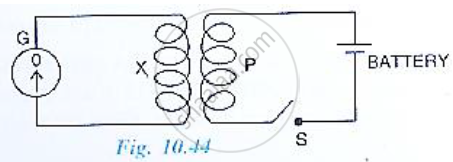
(a) Describe the observation when the switch S is (i) closed suddenly, (ii) then kept closed, (iii) finally opened.
(b) Name and state the law which explains the above observations.
An a.c generator generates an emf 'ε' where ε = 314 Sin (50πt) volt. Calculate the frequency of emf ε.
Draw a labelled diagram to show the various parts of a step-up transformer and step down transformer.
(i) Draw a clear labelled diagram of an electric bell.
(ii) Explain in brief, its working.
(iii) What material is used for the core of an electric bell? State the reason.
The primary coil of a transformer has 200 turns while the secondary coil has 1000 turns. What type of transformer is this? if the input voltage is 10V, what will be the output voltage?
A 220 V input is supplied to a transformer. The output circuit draws a current of 2.0 A at 440 V. If the ratio of output to input power is 0.8, then the current drawn by primary winding is ______.
A 60 W load is connected to the secondary of a transformer whose primary draws line voltage. If a current of 0.54 A flows in the load, what is the current in the primary coil? Comment on the type of transformer being used.
An iron rod of 0.2 cm2 cross-sectional area is subjected to a magnetising field of 1200 Am-1. If the susceptibility of iron is 599, then the magnetic flux produced is ______.
