Advertisements
Advertisements
Question
A device ‘X’ is connected to an a.c source. The variation of voltage, current and power in one complete cycle is shown in figure.
- Which curve shows power consumption over a full cycle?
- What is the average power consumption over a cycle?
- Identify the device ‘X’.

Advertisements
Solution
(a) Power is the product of voltage and current (Power = P = VI).
So, the curve of power will be having a maximum amplitude, equal to the product of amplitudes of voltage (V) and current (I) curve. Frequencies, of B and C are equal, therefore they represent V and I curves. So, curve A represents power.
(b) The full cycle of the graph (as shown by the shaded area in the diagram) consists of one positive and one negative symmetrical area.
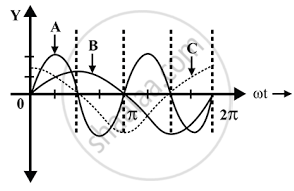
Hence, average power consumption over a cycle is zero.
(c) Here phase difference between V and I is π/2 therefore, the device ‘X’ may be an inductor (L) or capacitor (C) or the series combination of L and C.
APPEARS IN
RELATED QUESTIONS
A capacitor acts as an infinite resistance for ______.
An AC source is rated 220 V, 50 Hz. The average voltage is calculated in a time interval of 0.01 s. It
The dielectric strength of air is 3.0 × 10⁶ V/m. A parallel-plate air-capacitor has area 20 cm2 and plate separation 0.10 mm. Find the maximum rms voltage of an AC source that can be safely connected to this capacitor.
Compare resistance and reactance.
When an ac voltage of 220 V is applied to the capacitor C, then ______.
An a.c. source generating a voltage ε = ε0 sin ωt is connected to a capacitor of capacitance C. Find the expression for the current I flowing through it. Plot a graph of ε and I versus ωt to show that the current is ahead of the voltage by π/2.
A 40 µF capacitor is connected to a 200 V. 50 Hz ac supply. The rms value of the current on the circuit is, nearly ______.
When an AC voltage of 220 V is applied to the capacitor C ______.
The resistance of a coil for d.c. is 5 Ω. In a.c., the resistance will ______.
What is the applied voltage at any instant when a capacitor is connected to an AC source?
What does \[v_m\] represent?
What is the average power over one complete cycle for a capacitor connected to an AC source?
What happens to the capacitive reactance when the capacitance is reduced at a fixed angular frequency?
What is the capacitive reactance of a \[15.0\,\mu\mathrm{F}\] capacitor connected to a \[50\,\mathrm{Hz}\] source?
Between which values does a current with peak current \[1.47\,\mathrm{A}\] oscillate?
How does inserting an iron rod into the inductor affect its inductive reactance?
