Advertisements
Advertisements
Question
An AC source producing emf ε = ε0 [cos (100 π s−1)t + cos (500 π s−1)t] is connected in series with a capacitor and a resistor. The steady-state current in the circuit is found to be i = i1 cos [(100 π s−1)t + φ1) + i2 cos [(500π s−1)t + ϕ2]. So,
Options
i1 > i2
i1 = i2
i1 < i2
The information is insufficient to find the relation between i1 and i2.
Advertisements
Solution
i1 < i2
The charge on the capacitor during steady state is given by,
`Q = C epsilon = epsilon _0C [cos(100pis^-1)]`
the steady state current is, thus, given by,
`i =(dQ)/dt = epsilon _0Cxx100pi [sin(100pis^-1)] + epsilon_0Cxx 500pi [sin({00pis)]`
c`
⇒ i = 100Cepsilon cos [(100pis^-1)] t + Ø_1+500piepsilon_0 cos [(500pis^-1)] + Ø_2]`
⇒ `i_1 = 100Cpiepsilon_0 & i_2 = 500C_piepsilon_0`
∴ i_2 > i_1
APPEARS IN
RELATED QUESTIONS
When an AC source is connected to a capacitor, there is a steady-state current in the circuit. Does it mean that the charges jump from one plate to the other to complete the circuit?
A current i1 = i0 sin ωt passes through a resistor of resistance R. How much thermal energy is produced in one time period? A current i2 = −i0 sin ωt passes through the resistor. How much thermal energy is produced in one time period? If i1 and i2 both pass through the resistor simultaneously, how much thermal energy is produced? Is the principle of superposition obeyed in this case?
Is energy produced when a transformer steps up the voltage?
A capacitor acts as an infinite resistance for ______.
The AC voltage across a resistance can be measured using
A bulb rated 60 W at 220 V is connected across a household supply of alternating voltage of 220 V. Calculate the maximum instantaneous current through the filament.
A device Y is connected across an AC source of emf e = e0 sin ωt. The current through Y is given as i = i0 sin (ωt + π/2).
- Identify the device Y and write the expression for its reactance.
- Draw graphs showing a variation of emf and current with time over one cycle of AC for Y.
- How does the reactance of the device Y vary with the frequency of the AC? Show graphically.
- Draw the phasor diagram for device Y.
When an ac voltage of 220 V is applied to the capacitor C, then ______.
In the LCR circuit shown in figure, the ac driving voltage is v = vm sin ωt.
- Write down the equation of motion for q (t).
- At t = t0, the voltage source stops and R is short circuited. Now write down how much energy is stored in each of L and C.
- Describe subsequent motion of charges.

Define Capacitive reactance.
An iron cored coil is connected in series with an electric bulb with an AC source as shown in figure. When iron piece is taken out of the coil, the brightness of the bulb will ______.
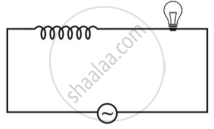
A resistor of 50 Ω, a capacitor of `(25/pi)` µF and an inductor of `(4/pi)` H are connected in series across an ac source whose voltage (in volts) is given by V = 70 sin (100 πt). Calculate:
- the net reactance of the circuit
- the impedance of the circuit
- the effective value of current in the circuit.
In an ac circuit an alternating voltage e = 200\[\sqrt 2\] sin100t volts is connected to capacitor of capacity 1 µF. The r.m.s. value of the current in the circuit is ______.
What is the charge on the capacitor at time \[t\]?
Which expression gives the capacitor current in terms of peak current \[i_m\]?
What is the peak current in a capacitor connected to an AC source?
What happens to the current if the frequency is doubled while the applied voltage and capacitance stay the same?
